Coin Flip Wheel: Free Online Heads or Tails 50/50 Spinner
An unbiased 50/50 decision maker with zero guesswork. Switch smoothly between a suspenseful 3D Metallic Wheel and a physics-based 3D Spatial Coin Toss. Built with hardware-backed randomness (CSPRNG), an automatic Best-of-3 tournament scoreboard, and Freud’s gut-check intuition filter.
Why Spin a Wheel Instead of a Flat Coin Toss? (The Suspense Factor)
When two people can’t agree, flipping a coin is the oldest decision trick in history. But most digital coin flippers have a glaring flaw: they flash a flat 2D graphic in under 0.3 seconds. There is zero suspense, zero build-up, and the losing side inevitably protests: "Wait, I wasn't looking!" or "That was a glitch!".
The Spin The Wheel's Coin Flip Wheel solves this by blending pure 50/50 mathematics with genuine spinning suspense:
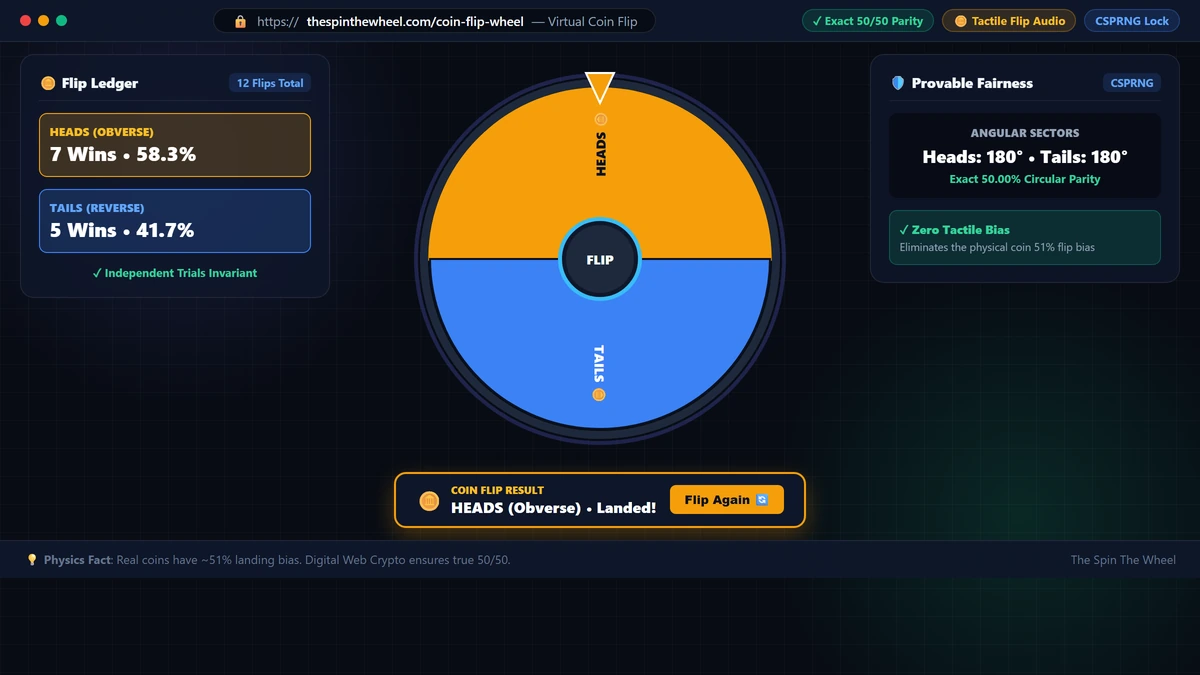
- The 3D Metallic Wheel: Watch a spinning wheel decelerate naturally across alternating Heads and Tails wedges. As the flipper clicks past each boundary, everyone in the room holds their breath until the pointer settles.
- The 3D Spatial Coin Toss: Prefer a classic toss? Toggle to the 3D coin simulator with realistic 3D tumbling physics, dynamic drop shadows, and a crisp metallic clinking sound synthesized via the Web Audio API upon landing.
- The Visual Slices Mystery (Why 2, 4, 8, or 12 Slices?): Does having 12 wedges change your odds? Not at all. Mathematically, Heads and Tails each occupy exactly 180° (π radians), locking the odds at a pure 50.00% (uniform arc geometry). But alternating wedges create intense visual suspense: in the final two seconds of deceleration, the flipper clicks across boundary lines 4 to 6 times faster, building real excitement without altering the math.
- Zero Line Ambiguity: Unlike real coins that can lean against an uneven surface or stick in the grass, the wheel's physics engine calculates stopping angles using micro-radian precision ($10^{-6}$ rad). The pointer will never land dead-center on a divider line—delivering a definitive verdict every time.
The 3-Step Anti-Drama Rule: How to Settle Any Dispute with Zero Excuses
Whether you're deciding who pays the restaurant check, who takes out the trash, or who picks starting sides in an esports bracket, disagreements happen when ground rules aren't established before the spin.
To eliminate protests and achieve total consensus, follow the 3-step binding protocol:
Define the competing alternatives unambiguously using custom decision labels (e.g., "Contract Acceptance" vs. "Counter-Proposal", or "Thai" vs. "Italian") with thematic visual skins. Both parties visually confirm the symmetric binary coordinates on-screen prior to resolution.
Determine governance conditions upfront: sudden-death single resolution or multi-round series. Best-of-3 (Bo3) or Best-of-5 (Bo5) tournament architectures activate automated series tracking, preventing post-hoc renegotiation.
Execute the commitment trigger. Both participants bind themselves in advance to the cryptographic outcome (P = 0.5000) as irrevocable and definitive—eliminating debate and activating immediate psychological clarity.
In Esports & Sports Tournaments: The higher-seeded team calls Heads or Tails prior to spinning. The winner secures side selection (Attack/Defend, Blue/Red) or map veto priority.
Resolving Disputes Remotely (Discord/Slack/Teams): Click "Copy Result" on the victory modal to paste the audit string complete with timestamp and SHA-256 pre-spin commit hash, or audit it independently via our public Audit Verifier.
Freud's Gut-Check Trick: What If You Secretly Hate the Result?
Have you ever flipped a coin, saw it land on Tails, and immediately felt a sinking feeling in your stomach? Psychologists study this under decision fatigue psychology, where externalizing a choice acts as a catalyst to reveal your true subconscious preference.
Danish polymath Piet Hein captured this in his famous 1966 grook "A Psychological Tip" (widely discussed in modern psychology alongside Sigmund Freud’s observations on ambivalence):
"When you are faced with two impossible alternatives, you simply toss a coin. Not because it settles the question for you, but because in that brief instant when the coin is in the air, you suddenly know what you are hoping for."
Our tool incorporates this insight directly into The Gut-Check Filter on the winner celebration popup:
- ✓ I accept this outcome: You feel a wave of relief when the winning side appears. That is your subconscious confirming alignment—proceed with total clarity.
- &flash; My gut wanted the opposite: You feel an instinctive twinge of disappointment. Do not ignore that emotional signal—the coin just did its true job by exposing your hidden desire. Select the opposite choice without hesitation!
The 50.8% Reality: Why a Digital Wheel Is Fairer Than a Real Pocket Coin
Most people assume pulling a real quarter from their pocket provides an impeccable 50/50 split. Modern physics and empirical statistical tests have proven this assumption wrong.
In 2024, researcher František Bartoš led 48 scientists across Europe who manually tossed physical coins 350,757 times across 46 currencies. Their landmark study tested the Stanford mechanical physics model by Persi Diaconis, Susan Holmes, and Richard Montgomery (2007). The team won the 2024 Ig Nobel Prize in Probability, with findings published in the Journal of the American Statistical Association.
The verdict was conclusive: physical coins land on the same face they started on 50.8% of the time (Pr = 0.508). When fingers toss a coin, off-axis wobble in mid-air keeps the starting face pointing up slightly longer. On top of that, standard stamped engravings create microscopic weight imbalances between the front and back faces.
How the Coin Flip Wheel Delivers Flawless 50.0000% Parity:
- Hardware Cryptographic Entropy: Rather than relying on pseudo-random generators like
Math.random(), our engine draws physical system noise via the browser's native Web Cryptography API (CSPRNG architecture). This completely eliminates human finger torque and physical weight bias. - Zero Memory (Independence of Trials): While hitting 4 consecutive Heads can happen naturally (a 6.25% probability), each spin is strictly independent, thoroughly debunking the Gambler’s Fallacy. Past spins exert zero pull over future spins.
- The Law of Large Numbers (LLN) in Action: Click the "Simulate 100 Flips" button above to watch 100 consecutive Bernoulli trials run in 0.2 seconds. You will see firsthand how short-term streaks dissolve and empirical variance converges symmetrically toward theoretical 50.00% equilibrium. (By comparison, across the first 58 NFL Super Bowls through 2024, the pre-game coin toss yielded 30 Tails and 28 Heads—an empirical 51.7% / 48.3% split reflecting this exact statistical variance).
Which Decision Tool Fits Your Situation? (Pocket Coin vs. Wheel vs. Yes/No)
Choose the right decision modality based on your specific social context, stakes, and audience:
| Decision Method | Setup Speed | True 50/50 Fairness | Dispute Scoreboard | Screen Share / Stream | Best Used For |
|---|---|---|---|---|---|
| Physical Pocket Coin | Immediate | 50.8% (Biased by wobble) | Manual memory | Poor (Falls off-camera) | Solo decisions on the go when completely offline. |
| Coin Flip Wheel (This Tool) | 1 Click (0s) | 50.00% (CSPRNG Locked) | Automated Bo3 / Bo5 / Bo7 | Excellent (Smooth 60 FPS) | Binary choices, sports/esports side picks, couple bets, classroom LLN demos. |
| Yes or No Wheel | 1 Click (0s) | 50.00% or 33.3% (Maybe mode) | Automated Bo3 | Excellent | Direct "Should I do it?" questions with optional mystery reveal. |
| The Spin The Wheel (Master Hub) | 1–2 mins (Custom text) | Uniform (1/N per slice) | Elimination mode | Excellent | Multi-option choices (3 to 100+ names, restaurants, or prizes). |
Frequently Asked Questions (FAQ)
Is the Coin Flip Wheel truly a 50/50 fair probability?
Yes. The Coin Flip Wheel is mathematically locked to a strict 50.00% probability. It utilizes the browser's hardware-backed Web Cryptography API (window.crypto.getRandomValues) rather than standard pseudo-random functions like Math.random(). Each flip or wheel spin draws physical entropy from system hardware, guaranteeing zero cyclical bias, zero patterns, and absolute 50/50 fairness.
Why is the Coin Flip Wheel fairer than tossing a real physical coin?
In a landmark international study awarded the 2024 Ig Nobel Prize in Probability (analyzing 350,757 human coin tosses across 46 currencies), researchers confirmed that physical coins have a 50.8% same-side bias due to subtle off-axis precession wobble during human flight. The Coin Flip Wheel completely eliminates finger torque and coin weight embossing imbalances by generating pure hardware entropy via CSPRNG, delivering flawless 50.0000% parity.
What is the difference between the 3D Metallic Wheel and the 3D Coin Toss mode?
Mode 1 (3D Metallic Wheel) provides the dramatic suspense of a spinning wheel with milled coin ridges and 2 to 12 alternating Heads/Tails slices. Mode 2 (3D Spatial Coin Toss) transforms the canvas into a tumbling three-dimensional coin simulator with realistic Euler axis physics, dynamic drop shadows, and synthesized metallic clinking sound effects upon landing.
Can the wheel land on the line between Heads and Tails, or a coin on its edge?
No. The wheel's physics engine calculates stopping angles using micro-radian trigonometric precision (10-6 rad), guaranteeing the pointer decisively resolves to one discrete slice with zero line ambiguity. Unlike physical coins that stand on their rim roughly once in 6,000 tosses (Murray & Teare, 1993), this digital simulator guarantees a definitive 50/50 binary outcome on every spin.
How does the Best-of-3 (Bo3) Tournament Series settle disputes?
When you select Best of 3, Best of 5, or Best of 7 mode, an integrated scoreboard tracks round victories automatically. The first choice (Heads or Tails) to secure the required majority of round wins triggers celebratory fanfare audio and confetti. This mode is widely used by esports teams, sports captains, and friends to settle disputes conclusively without complaints of a fluke flip.
What is Sigmund Freud's Coin Paradox and how does the Gut-Check filter work?
When facing a tough dilemma between two choices, flipping a coin reveals your true preference. In the split second before or as the coin lands, your brain experiences an instant emotional reaction. If you feel relief, your subconscious agrees with the outcome. If you feel a twinge of disappointment, your gut wanted the other option all along. Our Gut-Check filter prompts you to spot and act on that revelation.
How does the 100-Flips Simulation demonstrate the Law of Large Numbers (LLN)?
In small samples (like 5 flips), short streaks such as 80% Heads happen naturally due to variance. Clicking 'Simulate 100 Flips' runs 100 consecutive cryptographic trials in 0.2 seconds. As the sample size expands, the empirical ratio converges steadily toward the theoretical 50.00% expectation, demonstrating the Law of Large Numbers in action.