Elimination Wheel: Free Knockout Spinner & Survivor Picker
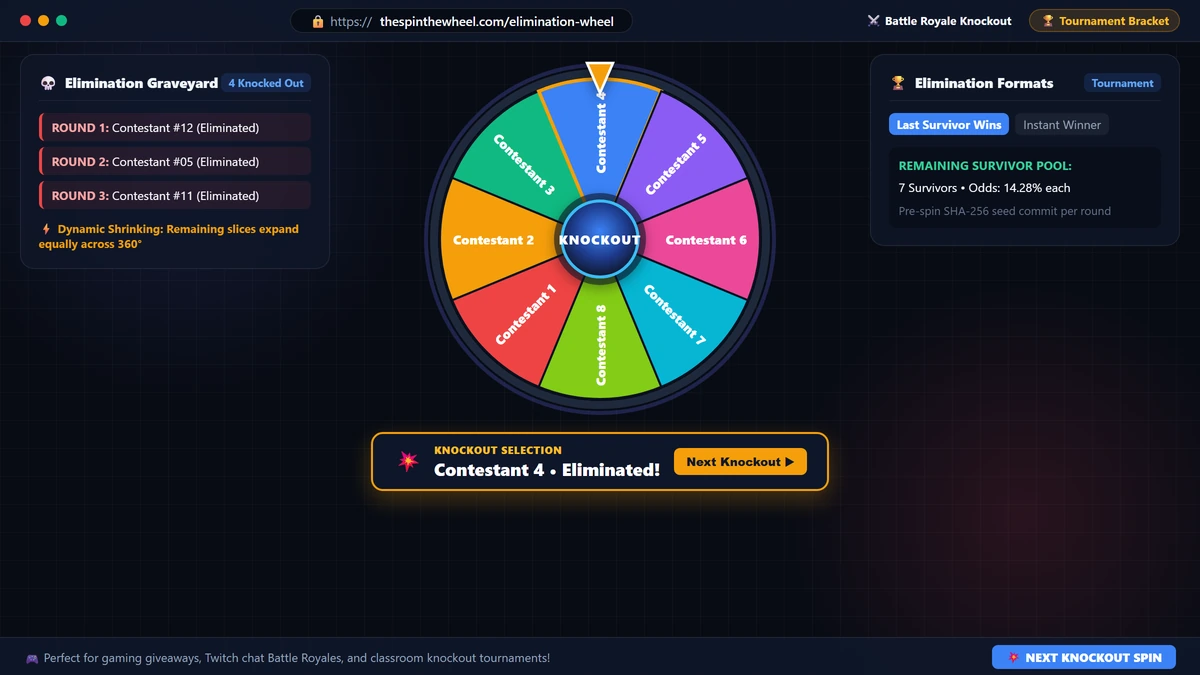
The Elimination Wheel pairs the suspense of a spinning wheel with the structure of a knockout tournament. When you spin, selected names drop off the wheel, slice odds update immediately, and winners advance through bracket rounds or survive to the last-man-standing podium.
Dynamic Live Bracket Arena
Connected tournament tree spanning Quarterfinals, Semifinals, and the Championship Match. Winners advance automatically to the next round with zero manual entry.
Battle Royale Slice Removal
Selected options leave the active circle immediately. The wheel recalibrates slice angles and odds for remaining participants on every spin.
Automated "BYE" Allocation
Handles irregular counts like 5, 6, 7, 10, or 14 participants mathematically. First-round byes balance the tree by Round 2.
Hardware CSPRNG & Zero-DB Privacy
Driven by Web Cryptography entropy (crypto.getRandomValues) with SHA-256 pre-spin commit hashes. No server database storage.
How Elimination Works: Automatic Slice Removal vs. Standard Wheels
A standard custom wheel spinner keeps every slice on the wheel after each spin, so each option always has the same $1/N$ chance. You could spin five times and land on the same name every time.
The Elimination Wheel works differently. Each spin permanently removes the selected slice from the active pool:
Selected element e_t chosen via Web Crypto CSPRNG
Next state: S_(t+1) = S_t \ { e_t }
Remaining count: |S_(t+1)| = |S_t| - 1
To examine hardware randomness benchmarks and learn how cryptographic entropy prevents seed bias, explore our research on CSPRNG entropy vs. Math.random().
The Escalating Tension Curve: As fewer slices remain, the chance of any single name landing rises after every round:
In an 8-player knockout, the stakes climb rapidly:
- Round 1 (8 alive): 1/8 = 12.5% risk of selection.
- Round 4 (5 alive): 1/5 = 20.0% risk.
- Round 6 (Top 3): 1/3 = 33.3% risk.
- Final 2: 1/2 = 50.0% head-to-head showdown.
Remaining slices expand visually to occupy the full circle, increasing suspense as the contestant pool narrows.
2 Ways to Play: Battle Royale Survival vs. 1v1 Tournament Brackets
You can run the Elimination Wheel in two distinct formats depending on your event:
| Dimension | Battle Royale (Survival) | 1v1 Tournament Bracket |
|---|---|---|
| Visual Structure | Single wheel containing all active participants | Multi-round connected tournament tree (Quarters, Semis, Finals) |
| Ideal Roster Size | 3 to 12 participants | 4, 8, 16, or 32 contestants (supports odd counts via Byes) |
| Elimination Pace | Rapid-fire: exactly 1 participant removed per spin | Match-by-match: 1 winner advances, 1 loser departs |
| Primary Use Case | Party games, classroom turns, raffle drafts | eSports showdowns, sports brackets, debate competitions |
| History Tracking | Survival ledger with finish ranks (#8, #7...) and Undo support | Connected bracket lines advancing to championship podium |
Rules of Engagement: Knockout vs. Prize Draft:
- Knockout (Loser leaves): The pointer selects the eliminated player. That player moves to the finish ledger, and remaining players spin until one survivor is crowned.
- Prize Draft (Winner leaves): The pointer selects the 1st Place winner. That winner is withdrawn from the wheel, so subsequent spins for 2nd and 3rd place never repeat winners.
Step-by-Step Use Cases: Giveaways, Classrooms & Tournaments
Here is how event hosts, teachers, and tournament organizers set up their sessions:
1. Multi-Prize Raffle & Giveaway Protocol
When conducting giveaways with tiered rewards, you have two options for drawing order:
- Reverse Draw (Best for Livestreams): Spin for 3rd Place first, remove the winner, spin for 2nd Place, and finish with the Grand Prize showdown. This keeps viewers engaged until the final spin.
- Top-Down Draw (Traditional): Spin for 1st Place first. Because the winner leaves the wheel, subsequent drawings for secondary prizes are guaranteed never to produce duplicate winners.
For ticket-based drawings without names, see our dedicated guide on raffle number generation without repeats.
2. Academic Presentation Queues & Spelling Bees
Educators running quiz bowls, debate rounds, or presentation turns project the wheel on interactive smartboards. Removing students who have already presented keeps turns fair while eliminating participation anxiety, a technique explored in our guide on cold-calling students without anxiety. For standard classroom turns without knockout brackets, teachers can also use the Classroom Name Picker.
3. eSports Communities & Fighting Game Tournaments
Gaming organizers running Super Smash Bros, Street Fighter 6, or Valorant 1v1 duels seed brackets publicly over Discord screenshares. The wheel lets random chance determine initial pairings without accusations of favored seeding. Before tournament play, organizers can also balance team rosters with the Team Picker Wheel.
4. Fantasy Sports Drafts & Playoff Tiebreakers
Fantasy league commissioners often need an impartial way to set draft orders or resolve regular-season ties. Spinning the Elimination Wheel live on video turns draft selection into an event where each eliminated name locks in their draft position.
5. Corporate Hackathons & Pitch Competitions
When teams present project pitches at company hackathons, single-elimination brackets pair concepts head to head for audience-voted rounds.
Troubleshooting & Fair Play: Walkovers, Respins & The Undo Button
When running live competitions, unexpected match situations happen. Here is how to keep match outcomes clear and objective:
Contestant Disconnections & Walkovers
If a contestant disconnects or fails to show up for their match in 1v1 Bracket mode, you do not need to rebuild the bracket:
- Click the opponent's Winner → button on the Match card.
- The present player advances immediately as a walkover win, keeping the rest of the bracket intact.
The SHA-256 Respin Policy
Accidental respins often trigger disputes. The pre-spin hash prevents this:
- Pre-Spin Commitment: Before every spin, the tool computes a SHA-256 cryptographic hash of the target sector and displays it in the verification bar.
- No Mid-Spin Respins: Once the wheel starts rotating, the result stands as long as the pointer lands on a valid slice.
- Permissible Respins: A respin is only justified if an actual browser crash or connection drop interrupts the animation before deceleration.
Spectators can independently audit hash seeds after each round using our public Giveaway Verifier.
Fair Use of the ↺ Undo Button
In Battle Royale mode, clicking ↺ Undo returns the most recently eliminated participant back to the wheel. Use this to correct accidental double-clicks or test spins before the official round begins. When streaming, announce the undo publicly so viewers see the adjustment clearly.
Odd Participant Bracket Rules: How Automatic "Byes" Balance the Tree
In single-elimination play, every match eliminates one contestant. For N competitors:
- Total Matches Required: Exactly M = N − 1 matches to crown a champion.
- Tournament Rounds: Calculated by R = ⌈log2 N⌉. For 8 contestants, R = 3 rounds. For 16 contestants, R = 4 rounds.
- Match Cadence: In each symmetrical round, the match count is half the competitors entering that stage.
Solving Odd Participant Counts with the "BYE" Rule
Real-world rosters rarely match an exact power of two. Rather than forcing awkward play-in matches, the Elimination Wheel uses standard tournament bye math:
Nearest next power of two: P = 2^(ceil(log2(N)))
Total Byes Awarded: B = P - N
Opening Round Matches: M_1 = (N - B) / 2 = N - (P / 2)
Walk-Through Example (6 Contestants):
- Nearest power of two: P = 8.
- Byes awarded: B = 8 − 6 = 2 contestants receive first-round byes.
- Opening matches: M1 = (6 − 2) / 2 = 2 matches.
- Top seeds (#1 and #2) bypass Round 1 directly to the Semifinals. Contestants #3 vs #6 and #4 vs #5 contest the opening round.
- By Round 2, exactly 4 contestants remain (P = 4), restoring a clean, symmetrical bracket path through to the Finals. All bracket execution runs client-side in browser memory, ensuring tournament rosters, confidential bracket seeding, and match results remain strictly private on the host device.
How TheSpinTheWheel Compares to Traditional Bracket & Spinner Tools
Different events call for different tools. Here is when to use each approach:
When to Use Manual Hat Draws
Best for offline classrooms or board games without internet access. Lacks visual animation, audit logs, and automatic bracket trees.
When to Use Challonge / Battlefy
Best for multi-day conventions running double-elimination or Swiss formats. Requires account sign-ups, displays ads, and lacks an interactive wheel.
When to Use TheSpinTheWheel
Best for livestreams, classroom smartboards, and fast single-day events: instant 60 FPS Canvas visuals, automatic bracket sync, zero sign-up, and complete privacy.
For detailed head-to-head performance breakdowns, read our in-depth audit in the Wheel of Names & Spinner Alternatives Guide.
| Feature & Metric | TheSpinTheWheel | Challonge | Wheel of Names | Picker Wheel | MiniWebtool |
|---|---|---|---|---|---|
| Visual Bracket + Wheel Sync | Yes (100% Unified) | No Wheel | No Bracket Tree | No Bracket Tree | No Wheel |
| Entropy Generator | Hardware CSPRNG | N/A (Manual Entry) | crypto.getRandomValues | Math.random | Server PRNG |
| Pre-Spin SHA-256 Hash | Yes (Commit-Reveal) | No | No | No | No |
| Odd-Count Bye Automation | Yes (Instant Math) | Yes (Manual Config) | N/A | N/A | Yes (Text byes) |
| Auto-Simulation Sequence | Yes (1.5s Auto-Spin) | No | No | No | No |
| Battle Royale Mode | Yes (Survival Ladder) | No | Remove slice only | Remove slice only | No |
| Account & Registration | 100% Free / No Login | Account Required | Google Login for saves | Paywall >15 wheels | Free / Heavy Ads |
| Data Privacy & Storage | 100% Stateless (Zero DB) | Server DB Log | Google Drive OAuth | Server Database Log | Tracking Cookies |
| Export Capabilities | Markdown, CSV, Print, URL | Embed / PDF (Paid) | Plain text list | Image download | Print text only |
| Mobile Performance & Ad Load | Sub-second LCP (<0.8s) / Zero Ad Bloat | Script-heavy SPA / Slower LCP | Ad network overhead (Freestar) | Ad & tracker network payloads | Third-party ad latency |
| OBS Streamer Overlay | Yes (Transparent Theme) | No | No | No | No |
| Ad Clutter & Popups | Clean / Zero Popups | Banner ads & upsells | Freestar banners | Heavy banner ads | Intrusive ads |
Frequently Asked Questions About the Elimination Wheel
What is the mathematical difference between an Elimination Wheel and a standard wheel? +
A standard wheel keeps every slice after spinning, so each option always has an identical 1/N chance. The Elimination Wheel samples without replacement: chosen slices are removed from the wheel. This raises the odds for remaining options after every round until two finalists face off at 50/50.
How does the tool handle an odd number of participants or bracket 'Byes'? +
When your roster is not a power of 2, the algorithm finds the next power of two P and awards B = P - N byes. Top-seeded players skip Round 1 and advance directly into Round 2, keeping the tournament tree balanced.
Can I use the Elimination Wheel for both 'Last Man Standing' and 'Raffle Prize Draws'? +
Yes. In Battle Royale mode, you can play by two rules. In Knockout mode, the selected person is eliminated until one champion survives. In Prize Draft mode, the selected person wins 1st place and is removed, so later spins award 2nd and 3rd place without duplicates.
Can I run an automated hands-free tournament simulation? +
Yes. Click 'Auto-Simulate' to spin through every matchup automatically with a 1.5-second celebration between rounds. This works well for livestreams and quick classroom seeding.
Can I export or print the generated tournament bracket? +
Yes. Click 'Copy Bracket' for a Markdown tree, click 'Export CSV' for a spreadsheet match ledger, or click 'Print Bracket' for a clean printable layout.
Is any tournament entrant or match outcome data stored on remote servers? +
No. The Elimination Wheel operates 100% locally in your web browser memory. Participant rosters, bracket seeds, and elimination logs remain strictly on your device and are compressed directly into the shareable URL fragment with zero external database storage.