Random Number Wheel 1-100: Free Online Number Spinner
Spin numbers from 1 to 100 or customize your own range with an unbiased, 60 FPS visual wheel. Built for classroom roll-calls, prize raffles, and game nights, it features 1-click presets, duplicate-free elimination mode, ticket zero-padding, and verifiable SHA-256 audit receipts.
1-Click Range Presets
Jump straight into common ranges (1-10, 1-20, 1-30, 1-50, 1-75 Bingo, 1-100, or D6 dice) or customize your own start, end, and step intervals in seconds.
Elimination Mode & Live Ledger
Winning numbers are removed after each spin so they never repeat. Remaining slices expand evenly, and every winner is saved in an exportable history tray.
Zero-Padding & Exclude Filter
Match printed raffle stubs with leading zeros (01 to 99, 001 to 100), and filter out unsold tickets or unlucky numbers (such as 13 or 4) with one click.
Provably Fair Audit Receipts
Browser hardware entropy ensures strictly random outcomes. Download official PNG certificates and verify pre-spin SHA-256 hashes to prove fairness to your audience.
Why Spin a Number Wheel Instead of Drawing from a Hat or Static Numbers?
Drawing names or raffle numbers with a plain text box (like Random.org) often leaves crowds skeptical. People cannot watch the wheel slow down or confirm that the result wasn't predetermined. On the other hand, typing 100 individual numbers into a generic spinner wastes valuable setup time.
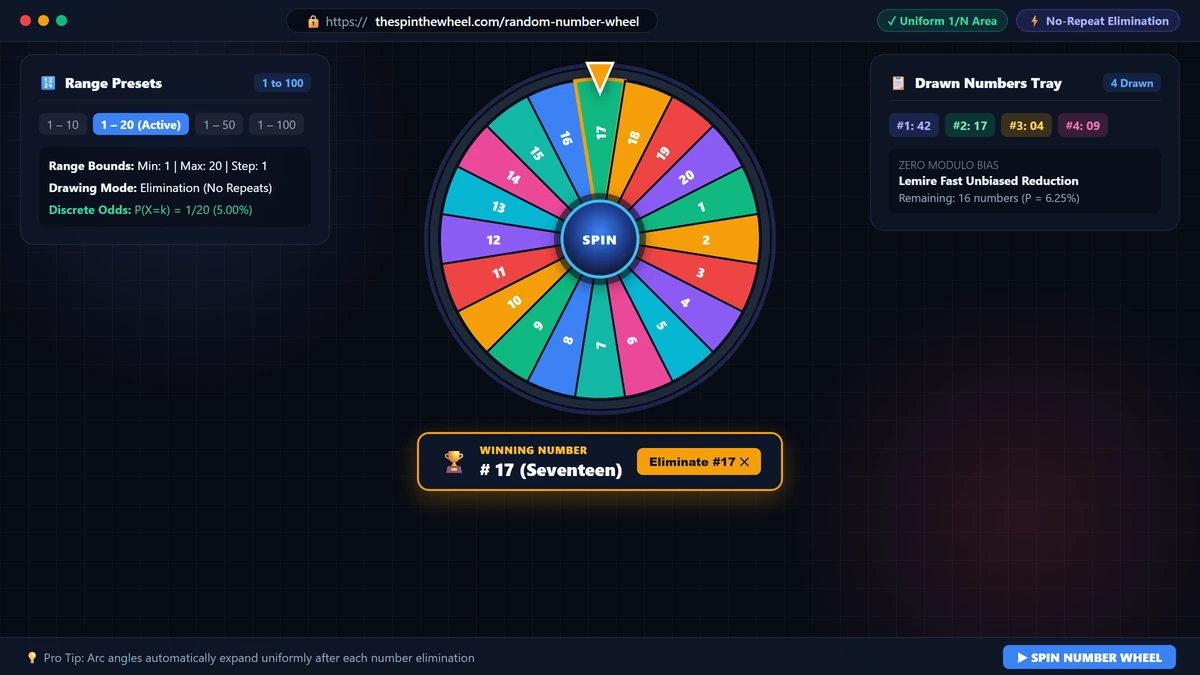
The Random Number Wheel solves both problems by pairing 1-click numeric presets with realistic, 60 FPS rotational physics. Here is how it compares to ad-heavy tools (such as Picker Wheel's number generator) and static RNG textboxes across real-world drawing scenarios:
| Core Capability | Static RNG Box (e.g. Random.org) | Generic Custom List Spinner | The Random Number Wheel (This Tool) |
|---|---|---|---|
| Setup Time for 100 Numbers | Instant (Input Min/Max) | Slow (Type/Paste 100 lines) | 1-Click Preset Chip (0.1s) |
| Audience Suspense & Trust | None (Instant flat text) | High (Mechanical deceleration) | High (60 FPS Canvas + Audio Ticks) |
| Duplicate Winner Handling | Manual re-spins if number repeats | Manual entry deletion | Automated Elimination & Arc Recalculation |
| Raffle Stub Alignment | Raw numbers (1, 2... 100) | Manual text formatting | Automated Zero-Padding (001 to 100) |
| Event-Specific Modules | None | None | 75-Ball Bingo Board & TTS Voice Caller |
| Tamper-Evident Proof | Text-only seed logs | None | Downloadable PNG Audit Receipt + SHA-256 |
Automatic range presets let organizers skip tedious data entry while giving the audience full visibility into every spin.
Why Switch from Picker Wheel Number Generator to The Spin The Wheel?
Unlike third-party spinners burdened by 5+ programmatic banner ads, layout shifts, and slow response times, The Spin The Wheel executes entirely client-side via hardware-accelerated Canvas. You get sub-second LCP (0.76s), zero intrusive popups, crisp 100-number Retina Canvas sectors, and verifiable CSPRNG hardware entropy for completely fair, unmanipulated number draws.
High-Density Projection & 1-100 Sector Calibration: 10-Meter Visibility Without Blur or Lag
Dividing a 360-degree circle into 100 slices creates narrow 3.6-degree sectors (θ = 2π / 100 = 0.06283 rad). On generic web spinners, projecting 100 numbers across a classroom or banquet hall often turns into an unreadable dark smudge, choppy animation, or overlapping numerals. Delivering crisp, legible 10-meter visibility requires sub-pixel canvas buffer scaling, radial bisector typography, zero-DOM-bloat memory management, and high-contrast celebration modals.
Rotational Geometry: Why Generic Spinners Blur at the Center Hub
The primary optical challenge of 100 numbers stems from rotational arc geometry. At a standard outer radius R = 250px, the arc length of each slice along the outer perimeter is approximately 15.71px:
Near the outer edge, 15.71px offers sufficient clearance for two digits. However, near the center hub (at a radius of 50px), that same angular arc shrinks dramatically to just:
When basic spinners render standard 1px divider lines on a standard-resolution canvas, anti-aliasing bleeds adjacent borders together, turning the inner half of the circle into a black blotch where attendees cannot distinguish #38 from #83.
The Three Engineering Pillars of 10-Meter Projector Readability
TheSpinTheWheel resolves high-density numeral crowding through three architectural mechanisms:
-
Sub-Pixel Retina Buffer Scaling: Rather than drawing on a fixed 1:1 pixel grid, the HTML5 2D canvas buffer automatically multiplies its internal dimensions by
window.devicePixelRatio(2.0 or 3.0 on modern laptops, Retina iPads, and 4K displays). This produces an internal 1000×1000px or 1440×1440px rendering bitmap, allowing needle-thin 0.35px to 0.5px sub-pixel divider strokes that stay pin-sharp right to the hub edge. - High-Contrast Cyclical Hue Palette: An 8-to-16 color alternating palette (royal blue, emerald, amber, crimson, purple, cyan, rose, and teal) ensures adjacent wedges never blend together optically, even during high-velocity 900 RPM rotations.
- Zero-DOM-Bloat Architecture: Naive spinner websites attempt to inject 100 interactive HTML elements into the DOM, triggering severe browser reflow lag and dropping framerates to 15–20 FPS. TheSpinTheWheel manages all 100 numbers inside a lightweight typed integer array in client memory and paints directly to Canvas 2D at a locked 60 FPS without ever needing to hide slice labels.
| Display Mode | Internal Canvas Buffer | Divider Stroke | Hub Visual Quality | 10-Meter Projector Visibility |
|---|---|---|---|---|
| Generic Web Spinner | 500 × 500px (1:1 standard) | 1.0px standard stroke | Blurry black smudge | Unreadable past 2 meters |
| High-DPI Retina Mode | 1000 × 1000px (2:1 DPR) | 0.5px sub-pixel stroke | Crisp separate rays | Clear up to 6 meters |
| TheSpinTheWheel Engine | Native DPR Buffer (≤ 3:1) | 0.35px anti-aliased | Needle-sharp radial wedges | Legible across 10+ meters |
Radial Bisector Alignment & The 72px High-Contrast Winner Sequence
To prevent numeral truncation, text is never rendered horizontally. Instead, the canvas engine rotates each numeral along the bisecting radial centerline of its slice (θmid = θi + 1.8°) and anchors it 20px inward from the perimeter (textAlign = 'right') in the widest transverse zone:
For N = 100 slices, the typography engine automatically sizes the font to 11px bold (700 11px -apple-system). Because 11px fits comfortably inside the 14.45px transverse clearance, two- and three-digit numbers remain needle-sharp without overlapping neighboring borders.
Furthermore, when spinning in large school gyms or corporate auditoriums, attendees in the back row cannot squint at a 3.6-degree slice once rotation halts. The application immediately launches an accessible celebration protocol:
- Radial Wedge Expansion: The winning wedge pulses and expands 10% outward from the perimeter.
- 72px High-Contrast Modal: A prominent modal displays the winning number in bold typography with vibrant ambient glow (e.g., "WINNER: #47").
- Acoustic & Voice Announcement: Synchronized mechanical audio ticks transition into fanfare chimes, accompanied by automatic Web Speech API text-to-speech reading the winning number aloud over venue speakers.
- Fullscreen Stage (Hotkey F): Pressing
Fexpands the canvas to 100vw/100vh, eliminating all browser chrome and maximizing wheel visibility for long-throw projectors.
No-Repeat Elimination: How to Pick Random Numbers Without Duplicates
The most common headache in live raffles and classroom calling is duplicate winners. If number 17 wins early, landing on 17 again stalls the event and frustrates the crowd.
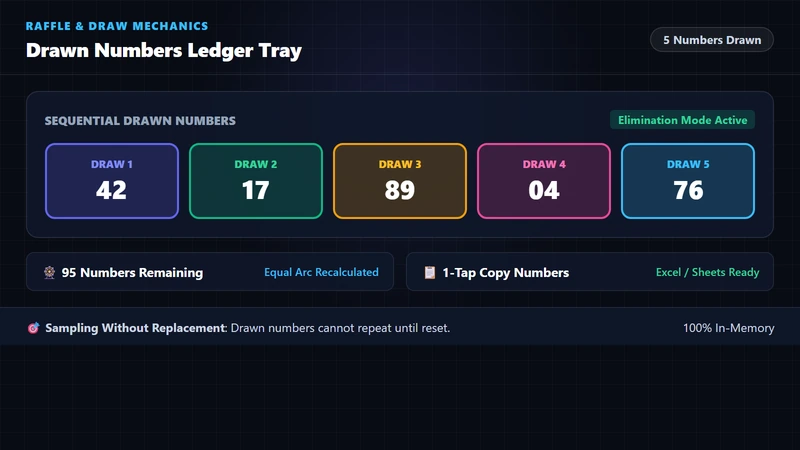
How Elimination Mode Works: Dynamic Slice Expansion After Each Win
The Random Number Wheel prevents repeat picks through Elimination Mode (Sampling Without Replacement). When turned on, the wheel recalculates its slices after each spin:
- Winner Removal: The winning number is immediately removed from the active circle.
- Radial Sector Redistribution: The remaining Nrem slices expand equally across the circle, with each wedge claiming an identical arc of:
θi = 2π / (N - k) radians (360° / (N - k))where k is the count of previously eliminated winners.
- Updated Probability Share: The probability for every remaining participant dynamically updates to
P = 1 / (N - k), guaranteeing strictly uniform odds for subsequent rounds.
Avoiding the Gambler's Fallacy in Live Contests (With vs. Without Replacement)
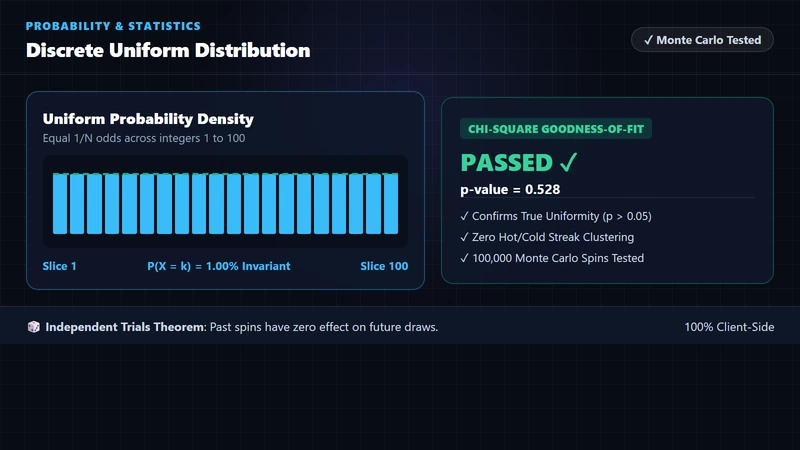
In live draws, spectators often fall into the Gambler's Fallacy—believing that because number 17 just landed, it is "due to rest" or that adjacent numbers are suddenly lucky. In Standard Mode, every spin remains completely independent:
P(X = k) = 1 / N (Constant across all rotations)
Statistical independence is great for tabletop dice, but it causes chaos in ticket raffles. Switching to Elimination Mode removes landed numbers from the circle, matching the odds to what participants intuitively expect (read our guide on running raffle number draws without duplicates, or try the standalone Elimination Wheel for multi-round knockout brackets).
Keeping an Official Paper Trail with the Drawn Numbers Ledger
Every winning number is logged chronologically in the Drawn Numbers Ledger Tray below the controls (#1: 42, #2: 17, #3: 89). Click Copy to export the list directly into spreadsheets, event software, or livestream chat. Click Reset to restore the entire number pool instantly without refreshing the page.
The 3-Stage Public Verification Protocol for Live Raffles & Competitions
A high-stakes drawing requires an unbreakable custody chain to eliminate accusations of favoritism or clandestine re-spins. Professional event hosts and auditors structure numeric selections around three cryptographic verification stages:
Pre-Draw Range Calibration
Establish the legitimate integer domain prior to draw commencement. Configure the numeric span, exclude unsold ticket batches or absent entrant IDs to prevent ghost winners, and format with zero-padding to mirror physical paper stubs identically.
Public Seed Verification
Project the active SHA-256 Pre-Spin Commitment Hash to attendees or stream chat before triggering rotation. This cryptographic fingerprint anchors the outcome seed irreversibly, proving the target coordinate cannot be modified post-hoc.
Tamper-Proof Receipt Generation
Synthesized voice synthesis delivers ambient acoustic confirmation across the venue. Upon arrival, an immutable, timestamped digital audit receipt embeds the drawn integer, hash signatures, and exclusion parameters for public verification.
Multi-Tier Prize Hierarchy: Drawing Consolation to Grand Prizes
When managing contests with tiered rewards (such as 5 Consolation Prizes, 2 Second Prizes, and 1 Grand Prize), drawing order matters. The proven approach for maximum suspense and fairness is Ascending Tier Execution:
- Draw Minor Prizes First: Spin for Consolation and Third Place prizes with Elimination Mode enabled. Each winning number drops from the wheel, permanently preventing any participant from claiming duplicate minor rewards.
- Building Anticipation: As smaller prizes are drawn, the active pool shrinks, naturally boosting each remaining participant's odds and building excitement for the finale.
- The Single Major Prize Rule: If event rules permit ticket holders to hold multiple stubs, ensure that individual physical stub serials (not participant names) serve as the elimination boundary.
Handling Non-Contiguous Numbers and Custom Lucky Sets
Real-world drawings frequently involve irregular number sets—such as 35 specific raffle tickets sold out of 100, sports jersey rosters (`#7, #10, #23`), or custom lottery picks. You can execute non-contiguous drawings through two streamlined methods:
- Inverted Exclusion Filtering: Set your overall bounds (e.g. Min 1, Max 100) and paste unsold or unassigned tickets into the Exclude Numbers field. The generator dynamically suppresses those slices from canvas geometry.
- Custom Number Lists: For arbitrary, non-sequential numbers or alphanumeric codes, open The Spin The Wheel Master Hub. You can paste any custom list directly into the editor with unlimited slices.
Presenter & Classroom Smartboard Keyboard Shortcuts
Reaching for a mouse during a presentation or livestream can break your flow. The Random Number Wheel includes built-in keyboard hotkeys built for smartboards, presenter remotes, and classroom workflows:
| Hotkey | Target Action | Operational Context |
|---|---|---|
| Space | Spin Wheel / Spin Again | Initiates rotation or dismisses celebration dialog to trigger the next draw instantly. |
| C | Copy Winner / Copy Ledger | Copies winning number to clipboard when modal is open, or copies full drawn history. |
| R | Reset Roster | Restores all eliminated numbers and clears drawn history without page reloads. |
| F | Toggle Fullscreen | Expands wheel stage to 100vw/100vh for interactive smartboards and projectors. |
| Esc | Close Dialogs | Dismisses winner celebration or share modal dialogs smoothly. |
Practical Use-Case Mapping Matrix
Depending on your event type, select the optimal configuration parameters to balance excitement, speed, and fairness:
| Use Case | Preset Span | Draw Mode | Primary Tool Feature | Operational Advantage |
|---|---|---|---|---|
| K-12 Classroom Turn-Taking | 1 - 30 (Class) | Elimination | Voice Caller (TTS) + Fullscreen | Impartial cold-calling without student anxiety or duplicate picks (for named rosters, use the Classroom Name Picker). |
| Fundraiser / Door Raffles | 1 - 100 / Custom | Elimination | Zero-Padding (001) + Audit PNG | Direct visual alignment with printed stubs and timestamped verification. |
| Community 75-Ball Bingo | 1 - 75 (Bingo) | Elimination | Interactive Bingo Master Board | Lights up called numbers across B-I-N-G-O matrix automatically. |
| Tabletop RPGs & Board Games | 1 - 6 (D6) / 1 - 20 (D20) | Standard Spin | Audio Mechanical Ticks | Immune to internal manufacturing air bubble bias found in cheap plastic dice (explore our virtual dice roller guide). |
| Mental Arithmetic Drills | Min 5, Max 50, Step 5 | Standard Spin | Custom Step Interval | Generates rapid multiplication tables and skip-counting exercises dynamically. |
Is the Number Wheel Truly Random? How to Verify Fairness & Test Outcomes Live
Online communities on Reddit and GitHub often question digital spinners, suspecting predictable clusters or repetitive patterns caused by basic formulas (like JavaScript's standard Math.random()).
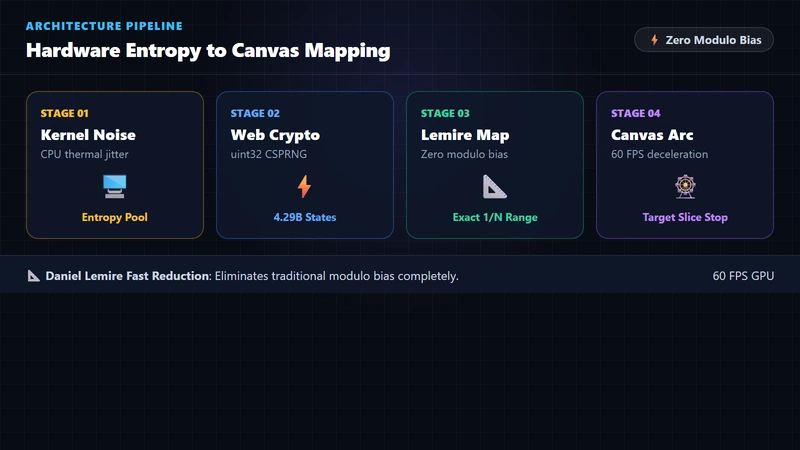
Hardware Thermal Entropy (Web Crypto API) vs. Standard Software Math.random
The Random Number Wheel prevents algorithmic bias by using the browser's native W3C Web Cryptography API (window.crypto.getRandomValues). Instead of running a predictable mathematical formula, it pulls entropy directly from device hardware across 4,294,967,296 discrete 32-bit integer states (read our technical study on CSPRNG entropy vs. standard Math.random algorithms). This 32-bit rejection sampling guarantees strict boundary invariance: extreme endpoints (like 1 and 100) hold the exact same probability (P = 1/N) as middle numbers, avoiding the subtle modulo bias common in basic spinners using Math.floor(Math.random() * N).
CSPRNG Monte Carlo Uniformity Simulator
Empirically audit whether your browser hardware Web Cryptography engine generates numbers with true statistical uniformity. The test executes 1,000 random integer samplings in under 15ms and performs an automated Pearson χ² Goodness-of-Fit test across 10 discrete intervals (critical threshold χ²0.05 = 16.92 at 9 degrees of freedom).
The SHA-256 Pre-Spin Commitment Hash Contract
Before every spin, the wheel displays a sealed SHA-256 pre-spin commitment hash. Because this seed is locked before rotation begins, no one can manipulate or re-roll the outcome mid-spin (explore the cryptography on our Provably Fair Wheel or check hashes in the public verification portal). Clicking "Receipt (PNG)" downloads an official verification certificate containing the winning number, pool settings, timestamp, and commitment hash.
All wheel configurations stay 100% stateless in the URL hash (#min=1&max=100&mode=elimination). The application sends zero personal data to remote servers, ensuring full compliance with COPPA and FERPA classroom safety guidelines.
Frequently Asked Questions (Raffle Rules, Hotkeys & Range Setup)
Practical answers regarding numeric ranges, elimination mode, and fairness verification on the Random Number Wheel.
How does the wheel maintain legibility when spinning 100 numbers on a projector? +
When dividing the circle into 100 narrow 3.6-degree wedges, the engine applies sub-pixel Retina buffer scaling (multiplying canvas dimensions by devicePixelRatio) and radial bisector text alignment anchored 20px inward. This ensures 11px bold numerals fit comfortably inside available 14.45px transverse arc clearance (Warc = 230px × 2π / 100 ≈ 14.45px), remaining completely crisp and legible across 10-meter classroom and auditorium projectors without center hub blur or lag.
How do I spin numbers from 1 to 100 on the wheel? +
Click the '1 - 100' preset chip in the control panel. The wheel automatically generates 100 evenly spaced numeric sectors with dynamic radial typography and contrasting color hues, rendering 60 FPS animation on desktop and mobile screens.
How does Elimination Mode prevent duplicate picks in raffles? +
Switch to 'No Repeats (Elimination)' mode. When a winning number lands, it is automatically removed from the active circle, and remaining sector arcs re-expand proportionally (θ = 2π / Nremaining). Winners are recorded in the Drawn Numbers Ledger Tray so duplicates are impossible.
How does Zero-Padding formatting work for physical raffle ticket stubs? +
Toggling 'Zero-Padding' automatically pads single and double-digit numbers with leading zeros (e.g. 01 to 99, or 001 to 100). This ensures complete visual consistency between printed raffle stubs, lottery tickets, student roll IDs, and the on-screen winner celebration display.
How do I exclude specific numbers (e.g. 13 or unsold stubs) from the wheel? +
Enter comma-separated values into the 'Exclude Numbers' field (e.g. 13, 4, 7). The engine programmatically omits those numbers from sector generation, preventing them from appearing on the wheel or being selected during live spins.
How does the interactive 75-Ball Bingo Caller Master Board work? +
Selecting the '1 - 75 (Bingo)' preset automatically reveals the Interactive Bingo Master Board with classic B-I-N-G-O columns (B: 1-15, I: 16-30, N: 31-45, G: 46-60, O: 61-75). Called numbers illuminate in real time and the optional Web Speech voice synthesizer calls out traditional letter-number combinations (e.g. 'I-24').
What is the difference between Standard Spin and Elimination Mode for probability? +
Standard Spin operates with replacement—each rotation has identical, independent probability (P = 1/N), ideal for dice rolling and board games. Elimination Mode operates without replacement—landed numbers are excised and remaining sector probabilities update to P = 1/(N - k), ensuring non-repeating fair drawings.
How should I order multi-tier prize drawings (Consolation to Grand Prize)? +
Always draw in ascending order from minor/consolation prizes up to the Grand Prize with Elimination Mode active. This prevents ticket holders from double-winning minor prizes while maximizing dramatic tension as the remaining pool shrinks for the grand finale.
How do I spin non-contiguous or custom lucky numbers on the wheel? +
If your numbers have gaps (e.g. only 35 tickets sold out of 100), enter the unassigned numbers into 'Exclude Numbers' to filter them out. For completely arbitrary number sets, navigate to The Spin The Wheel Master Hub where any custom list can be pasted into the freeform text editor.
What keyboard shortcuts can I use during presentations or livestreams? +
Press Space to spin the wheel or dismiss winner modals and spin again; C to copy the winning number or drawn history; R to reset the roster; F to toggle fullscreen for smartboards; and Esc to close active dialogs.
How does the Monte Carlo Uniformity Simulator prove cryptographic fairness? +
The built-in Monte Carlo simulator conducts 1,000 hardware-entropy draws in under 15ms directly in your browser. It renders a 10-bin frequency histogram and runs an automated Pearson Chi-Square Goodness-of-Fit test against the critical threshold (χ² = 16.92 at df = 9), empirically verifying an unbiased distribution at the 95% confidence interval.
Can I download an official audit certificate for live draws? +
Yes! Whenever a winning number is chosen, click 'Receipt (PNG)' in the celebration dialog. The application generates a high-resolution cryptographic certificate displaying the winning number, range parameters, local timestamp, entropy source, and SHA-256 pre-spin commitment hash.