Virtual Dice Wheel Roller: The Tabletop RPG Polyhedral Spinner Playbook
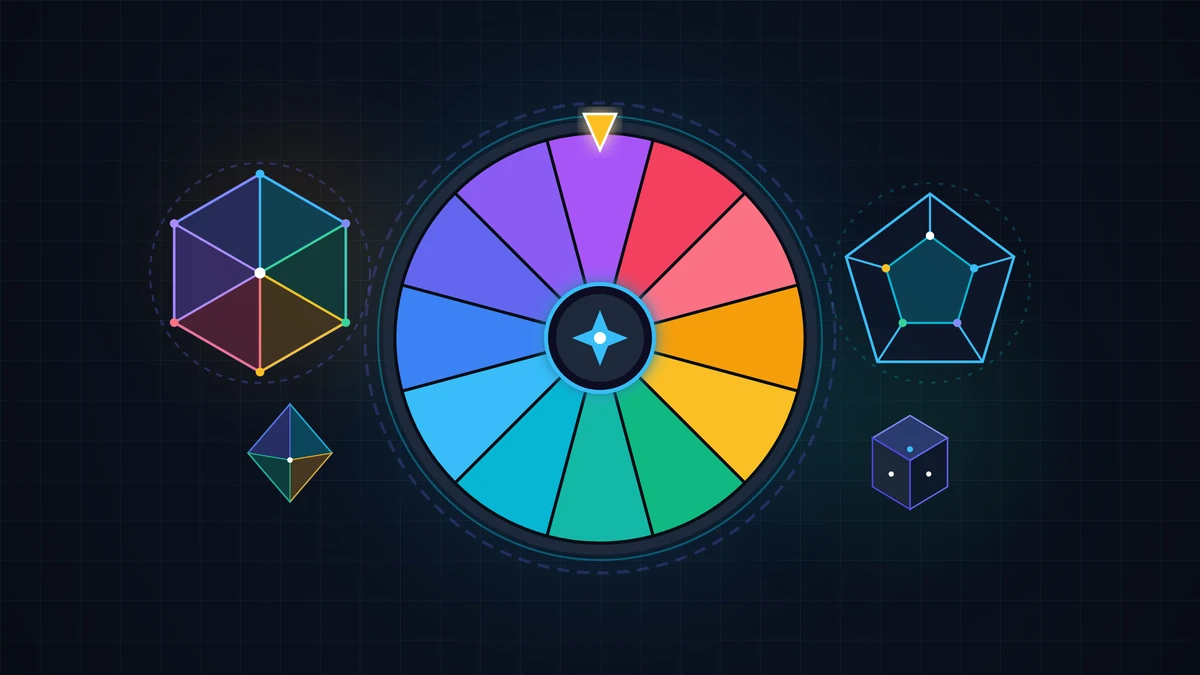
A virtual dice wheel roller is an interactive browser-based spinner that maps polyhedral tabletop dice (D4 through D100) onto equal circular slices, combining rotational physics and mechanical audio ticks to build shared table suspense. Silent Discord bots remove all anticipation, while 3D dice simulations often stutter over streams and lag on mobile screens. A lightweight 2D canvas wheel gives gaming tables an instant visual spin, zero logins, and provable cryptographic fairness for critical combat rolls.
🎲 1-Click Polyhedral Wheel Launchpad
Launch instant, calibrated dice configurations on The Spin The Wheel with zero setup time. Select any polyhedral die to spin immediately:
Building Tabletop Suspense with Audio Deceleration and Visual Spins
Rotational wheel deceleration pairs visual tracking with rhythmic audio clicks, turning a dry number generator into a suspenseful moment the whole table watches together.
Behavioral research in game design and reward anticipation reveals that a brief suspense window of 3 to 5 seconds triggers anticipatory dopamine ramping and heightens table focus without stalling combat tempo. As the digital pointer glides across slice boundaries, players track the deceleration curve together, generating collective excitement that static text rolls cannot match.

Why Discord Text Bots Kill Dramatic Tabletop Tension
Discord text command bots kill dramatic tension because they output numbers in zero milliseconds. Typing !roll 1d20 prints a line of text in under 50 milliseconds—the moment passes before players even react, turning a big boss fight into a flat chat notification. A spinning wheel gives the party a shared pause where everyone watches the pointer slow down together.
Mechanical Ticking and Rotational Friction as Psychological Drivers
Procedural audio ticks mimic the mechanical clatter of a carnival wheel, building tension as the pointer slows down near high-stakes numbers. Instead of looping recorded audio files, the engine uses the browser Web Audio API to synthesize micro-clicks directly. Tick frequency drops smoothly from 30 clicks per second down to a single click per second, matching the wheel's physical friction curve before coming to a stop.
Natural 20 Confetti Celebrations and Critical Fumble Drama
The emotional peak of tabletop combat hinges on extreme outcomes: a Natural 20 Critical Hit or a Natural 1 Critical Fumble. When the pointer edges past the final divider and locks onto 20, the emerald green slice and confetti trigger a loud celebration across voice chat. Players can tap C for instant confetti, turning an individual hit into a shared table moment. Conversely, landing on crimson red slice 1 delivers an immediate visual shock that fuels memorable narrative setbacks.
Polyhedral Wheel Configurations for Standard Tabletop RPG Dice Sets
Game Masters configure standard tabletop roleplaying dice into circular wheel layouts by dividing a 360-degree canvas into equal angular segments, ensuring identical probability to physical polyhedral dice sets.
Seven core polyhedral dice govern action resolution across modern systems like D&D 2024, Pathfinder 2e, Savage Worlds step dice (D4 through D12), and Call of Cthulhu sanity checks. When projected onto an HTML5 canvas, each face becomes an equal arc slice defined by θ = 360° / N, where N represents the face count.
| Die & Geometry | Slices (N) | Single Odds | Typical Application |
|---|---|---|---|
| D4 (Tetrahedron) | 4 slices | 25.0% | Dagger damage, Magic Missile, Healing Potion tier 1 |
| D6 (Cube) | 6 slices | 16.67% | Greatsword strikes, Fireball damage, ability generation |
| D8 (Octahedron) | 8 slices | 12.50% | Longsword one-handed slashes, Cure Wounds, rapier strikes |
| D10 (Trapezohedron) | 10 slices | 10.0% | Halberd damage, Eldritch Blast, tens percentile dice |
| D12 (Dodecahedron) | 12 slices | 8.33% | Barbarian Greataxe cleaves, Witch Bolt, Poison spray |
| D20 (Icosahedron) | 20 slices | 5.0% | Combat attack rolls, skill checks, death saving throws |
| D100 (Percentile) | 100 slices | 1.0% | Wild magic surges, loot tables, Call of Cthulhu Sanity and skill checks |
The Classic D20 Wheel for Combat Attacks and D20 Tests
The virtual D20 wheel divides the canvas into 20 equal 18-degree slices, turning death saves and contested attack rolls into moments everyone can track. High-contrast colors signal the biggest swings right away: emerald green (#10b981) marks a Natural 20 Critical Hit, while crimson red (#ef4444) flags a Natural 1 Critical Fumble. Remote Discord viewers and in-person players see the result clearly the moment the wheel stops.
Core Damage Dice from Four-Sided D4 to Twelve-Sided D12
Smaller polyhedral dice translate into wider slices, from 30 to 90 degrees, keeping numbers easy to read during fast encounters. Wide slices avoid visual crowding, so DMs can roll D4 healing potions or weapon damage with quick consecutive spins without squinting. D6 and D8 wheels handle the bulk of weapon strikes, battle maneuvers, and rogue sneak attacks.
Percentile D100 Mechanics for Loot Drops and Wild Magic Tables
Percentile rolling utilizes a calibrated 100-slice wheel to navigate massive random encounter compendiums in seconds without two-stage dice arithmetic. Dynamic radial font scaling ensures all 100 numbers remain sharp and legible on high-DPI displays without overlapping. This eliminates manual tens-and-units mental addition for Call of Cthulhu sanity checks and wild magic surges. For larger group games and tips on projecting 100 slices clearly, launch our Random Number Wheel 1-100.
Mathematical Uniformity and Cryptographic Fairness Across Wheel Slices
Virtual dice wheels eliminate physical manufacturing imperfections like air bubbles and weighted resin while maintaining exact discrete uniform probability across every face.
Geometric Parity: Why Canvas Slices Outperform Tumbled Acrylic
In standard salt water float tests, mass-market acrylic dice often rotate their heaviest side downward due to trapped air pockets or uneven glitter density. Lou Zocchi, founder of Gamescience, proved decades ago that factory rock-tumbling rounds dice edges unevenly, introducing physical roll bias. An HTML5 canvas avoids material defects entirely by calculating double-precision arc radians (θ = 2π / N), giving every slice the exact same mathematical area.
The Spindown Fallacy vs. Balanced Alternating Wheel Slices
Dungeon Masters strictly ban Magic: The Gathering spindown dice at roleplaying tables because numbers 20, 19, and 18 sit right next to each other. That physical clustering lets players use gentle drops to bias outcomes toward higher numbers. On a genuine polyhedral D20, opposite faces sum to 21 and high numbers alternate with low numbers across the surface.
On The Spin The Wheel, players never face spindown bias for two simple reasons. First, the stopping angle is chosen by hardware entropy across a uniform continuous circle (θ ∈ [0, 2π)), so soft spins cannot exist and every slice holds an exact 5.0% probability. Second, Game Masters can tap the Shuffle button to alternate numbers around the wheel, placing slice 20 directly between slice 1 and slice 2. This alternating layout delivers peak suspense, where a single millimeter of pointer drift separates a Critical Hit from a Critical Fumble.
Hardware Entropy Against Pseudo-Random Seed Predictability
The Spin The Wheel uses browser-level hardware entropy rather than predictable pseudo-random formulas. Standard JavaScript engines rely on algorithms like XorShift128+, which can repeat sequences or allow someone to reconstruct the seed after observing several consecutive rolls. By calling crypto.getRandomValues() directly, the wheel draws entropy from operating system thermal noise. This eliminates modulo bias and ensures every spin is genuinely independent. For an empirical benchmark comparing pseudo-random generators with hardware entropy, see our analysis of hardware entropy and CSPRNG wheel fairness.
Streamlining Live RPG Sessions with Modifiers, Advantage, and Player Agency
Game Masters keep live tabletop sessions fast by setting clear table habits for modifiers, damage pools, and keyboard shortcuts without leaving the combat grid.
Pre-configured URL parameters compress all dice parameters directly into the link, allowing Game Masters to bookmark and launch custom polyhedral wheels in under two seconds without creating user accounts.
Handling Modifiers and Target DC with the Pre-Spin Callout Protocol
A common question with virtual spinners is how to handle character modifiers, since the wheel displays the raw die face (1 to 20) rather than the modified total. To keep combat moving without cluttering the screen with math forms, experienced DMs use a simple pre-spin callout:
Before hitting spin, the player or GM states the modifier and target DC aloud (for example, "Rolling Rogue Stealth: +7 modifier against passive perception 15; we need an 8 or higher on the die"). When the wheel spins, the entire party knows the exact stakes. Landing on a 9 is an immediate hit ($9 + 7 = 16 \ge 15$) without anyone touching a keyboard or slowing down the fight.
Combat Pacing Budget and Resolving Multi-Dice Damage Pools
When a spellcaster drops an 8d6 Fireball or a Paladin unleashes a 5d8 Divine Smite, spinning an individual 5-second wheel for each die would consume 40 seconds, grinding combat tempo to a halt. Pragmatic GMs apply a Combat Pacing Budget:
- High-Stakes Single Rolls (Full 4.5s Spin): Reserve full wheel spins for major D20 moments: attack rolls against boss AC, death saving throws, contested spell saves, and monster recharge rolls. You can set the Random Number Wheel to 1–20 with one click for these key scenes.
- Bulk Damage Pools (Rapid Spacebar Taps): For multi-dice spells, tap the
Spacebarin rapid 1-second succession or run a single damage calculation die while keeping the wheel dedicated to high-stakes narrative swings.
Streamlining Advantage, Disadvantage, and Heroic Inspiration Rerolls
Dual-spin protocols allow gaming tables to resolve D&D 2024 / 5e advantage, disadvantage, and Heroic Inspiration rerolls in a single visual pass. For Advantage or Disadvantage on D20 Tests, the GM can spin consecutively using rapid spacebar taps or open two side-by-side browser windows for a simultaneous race spin. Modern D&D 2024 rules allow players to spend Heroic Inspiration reactively after seeing the roll result. If an attack falls short of the target DC, the player calls for Inspiration and taps Spacebar to spin again immediately. Single-key hotkeys keep hands free for battle maps and miniatures: Spacebar starts the spin, Esc dismisses the winner dialog, and C fires celebratory confetti.
Player Agency: DM Screen Broadcast vs. Player-Led Smartphone Rolls
A cardinal rule of tabletop etiquette is preserving player agency: players want to roll for their own characters rather than watching the Dungeon Master roll on their behalf. GMs can balance visibility with autonomy by sharing pre-configured URLs (such as /random-number-wheel#min=1&max=20) into Discord or group chats. Players open the link on their phones to spin their own attacks and skill checks. Meanwhile, the DM broadcasts the central wheel on stream for monster attacks, lair actions, and tense group saving throws. GMs can also explore our suite of custom wheel spinners for initiative trackers, NPC personality pickers, and random weather generators.
Troubleshooting Virtual Tabletop Display, Audio, and Stream Latency
Practical Game Master heuristics resolve streaming latency, audio clipping, and mobile rendering issues to ensure uninterrupted game flow across diverse player hardware.
Resolving Discord Video Stream Lag and Frame Drops
Lightweight 2D canvas wheels consume less than 15MB of RAM, avoiding hardware acceleration crashes common with 3D physics dice. Unlike heavy 3D WebGL physics engines that saturate GPU fill-rates, spike memory usage, and stutter over Discord video streams, 2D canvas wheels maintain smooth 60fps rendering. In Discord voice channels, GMs should right-click their active stream preview and uncheck "Show My Screen Share." This disables local decoding loopback, which is the primary cause of GPU frametime spikes when broadcasting browser canvas tools. Capturing the individual browser tab rather than the entire desktop, toggling browser full-screen (F11), or embedding an OBS Studio transparent overlay further ensures stutter-free 60fps broadcasts for Twitch and YouTube.
Calibrating Web Audio Volume for Virtual Tabletop Voice Channels
Balance the tick volume so it cuts through background music without drowning out voice chat. When streaming over Discord, setting the wheel volume between 35% and 45% prevents noise suppression from cutting off GM speech while keeping the clicks audible. Setting your stream output to 50% prevents audio clipping on player headsets.
Maintaining Mobile Browser Smoothness on Player Phones
Touch-friendly layouts let in-person players roll their own dice on mobile phones without installing any app. The tool runs directly in any browser, loading in under a second on mobile data with a sub-15KB footprint. The canvas automatically adjusts for high-DPI screens, and the central spin button is sized comfortably for easy thumb tapping.
Ready to Bring Cinematic Suspense to Your Gaming Table?
Launch the high-performance D20 dice wheel preset with mechanical audio ticks and hardware-backed cryptographic fairness. Zero login required.
Launch D20 Dice Roller Wheel →