Yes or No Wheel: Instant 50/50 Online Decision Spinner
The Yes or No Wheel is a free decision-making tool engineered for instant, fair binary choices with mathematically locked 50/50 odds. Running entirely in your browser with zero server tracking, it helps you break mental stalemates through customizable slice counts, Best-of-3 tournament scoring, and an intuitive gut-check prompt.
Locked 50/50 Parity
Symmetrical geometric slice pairs guarantee that cumulative arc lengths for YES and NO always equal exactly 180° (π radians), strictly locking probability at 50.00%.
Tournament Series
Automated Best-of-3 and Best-of-5 tournament counters track consecutive rounds on-screen, eliminating complaints of bad luck and demand for do-overs in group debates.
Gut-Check Filter
Based on Freud's coin-toss paradox, the reflection banner prompts you to evaluate your immediate emotional reaction. A flash of disappointment unmasks what you truly desired.
Hardware CSPRNG
Bypasses pseudo-random algorithms by deploying browser crypto.getRandomValues() backed by OS thermal noise, publishing SHA-256 pre-spin commitment hashes.
Is the Yes or No Wheel Truly Fair? How Alternating Slices Lock 50/50 Odds
A common worry when using online wheels is whether adding more slices tips the scale. The Yes or No Wheel is built with strict geometric symmetry, meaning your odds stay locked at 50/50 no matter how many alternating slices you choose.

The 180° Rule: Why 2, 4, 8, or 12 Slices Never Change Your Chances
Changing slice count never alters your odds because the total wheel area for each answer remains identical. In circular probability, the chance of the pointer landing on an option equals its total arc length divided by the full 360° circumference (2π radians).
For any even number of symmetrical alternating slices N ∈ {2, 4, 6, 8, 12}:
ΘYES = ∑i=1N/2 (2π / N) = (N / 2) × (2π / N) = π radians (180°)
ℙ(YES) = ΘYES / 2π = π / 2π = 0.5000 (50.00%)
Whether you choose 2 slices of 180° each or 12 alternating slices of 30° each, the cumulative angle reserved for YES always equals precisely 180° (π radians). Alternating emerald green (#10b981) and rose red (#ef4444) sectors heighten visual drama during rotational deceleration without introducing a single fraction of mathematical bias.

True Randomness: Why Physical Entropy Beats Fake Math.random Streaks
Standard web utilities rely on deterministic pseudo-random number generator (PRNG) algorithms like Math.random(), which are prone to cyclical seed repetition and artificial streaks. The Yes or No Wheel operates exclusively via the browser's native W3C Web Cryptography API (window.crypto.getRandomValues), sourcing physical entropy directly from operating system thermal noise and CPU interrupts.
Each spin also computes a cryptographic SHA-256 pre-spin commitment hash before motion begins, proving that the resting segment was determined prior to rotation and could not be tampered with mid-flight. For an in-depth empirical comparison of hardware entropy versus deterministic PRNG algorithms, consult our research on CSPRNG vs Math.random in Random Decision Wheels.
A frequent cognitive trap occurs when users witness a streak of identical outcomes: after landing on NO three times consecutively, they assume YES is "due" on the fourth spin. Under probability theory and the principle of Independent Trials, the wheel possesses zero memory. Every individual spin resets physical entropy, locking the probability of YES at precisely 50.00% regardless of past outcomes.
The Gut-Check Filter: How Instant Regret Reveals What You Truly Want
Psychologists estimate that the average adult makes around 35,000 micro-decisions every day. When two choices seem equally good—or equally bad—our brains easily get stuck in analysis paralysis. That hesitation drains willpower over minor daily choices that should take seconds. To learn more about this mental trap, explore our study on Decision Fatigue Psychology in Everyday Choices.
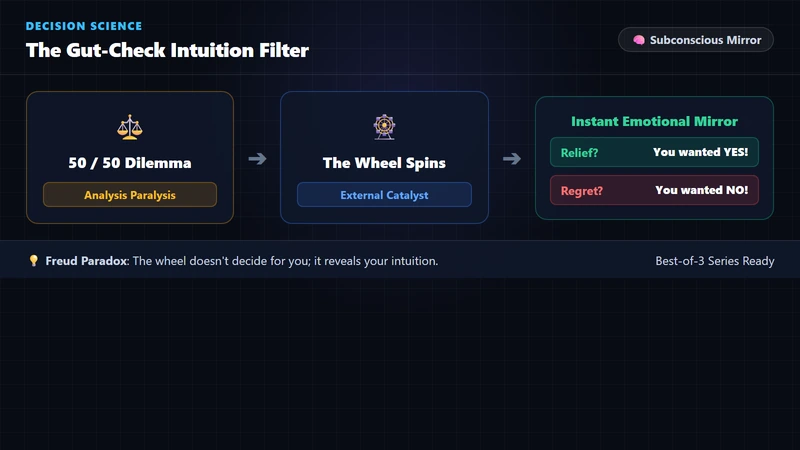
You do not have to obey the wheel blindly. A random spinner works best as a mirror for your intuition: it forces an outcome so you can instantly see how you feel about it.
The Freud Paradox: Why a Flash of Disappointment Means You Secretly Wanted "YES"
Popularized in decision psychology as the Freud coin-toss paradox, this insight reveals that delegating a choice to an impartial spinner cuts through mental overthinking. The moment the wheel slows down and stops, your gut reaction immediately tells you what you were secretly hoping for all along.
"How did you feel the moment the wheel landed on NO? If you experienced an immediate flash of disappointment, your subconscious intuition was actually pulling toward YES all along. Trust your gut and proceed with YES!"
This quick reaction transforms the spinner from a game of chance into a practical gut-check. By noticing your immediate feelings, you uncover what you actually wanted before your brain started over-rationalizing.
The Gut Override: When You Should Defy the Wheel and Trust Your Instincts
When your emotional reaction rebels against the wheel's verdict, execute the structured Gut Override Protocol:
- Acknowledge the Regret Signal: If the wheel indicates NO and you feel an involuntary pang of disappointment, recognize that signal as definitive proof that your subconscious had already chosen YES.
- Override with Absolute Confidence: You are 100% authorized to choose the opposite of what the wheel selected. Doing so is not "cheating"; it is honoring newly clarified intuition that conscious deliberation failed to uncover.
- Enforce Immediate Closure: Once you embrace the overridden decision, lock it in immediately. Refuse the temptation to re-spin the wheel seeking algorithmic validation—your dilemma is already resolved.
What to Do After You Spin: Ending Group Arguments and "Outcome Shopping"
The biggest pitfall with random decision wheels is "outcome shopping"—spinning, disliking the result, and spinning again until the wheel gives you the answer you wanted. Doing that defeats the entire purpose of using a decider and leaves you just as exhausted as before.
The 24-Hour Rule: Lock In Your Verdict and Stop "Just One More Spin"
To cement behavioral commitment and prevent compulsive re-spinning, the Yes or No Wheel incorporates the 24-Hour Decision Cooldown Rule:
- Affirmative (YES): The 15-Minute Micro-Action Directive. Rather than getting overwhelmed by the entire task, commit to executing the first sub-action within 15 minutes while initial momentum is high.
- Negative (NO): The Active Elimination Directive. The dismissed pathway is formally closed for 24 hours. You are barred from revisiting or re-spinning the dilemma until tomorrow's cognitive reset.
- Ambiguous (MAYBE): The Missing Data Protocol. In Trinary Realism mode, treat a MAYBE outcome as an active directive to identify exactly one missing piece of factual information within 24 hours rather than a passive excuse to procrastinate. If MAYBE appears twice consecutively, transition immediately into a Best-of-3 binary playoff to force resolution.

Best-of-3 Mode: Settle Classroom and Team Disputes with Zero Arguments
A single spin in a game, classroom activity, or team meeting often sparks complaints of bad luck or calls for a do-over. Tournaments and sports use multi-round series for a reason: they wash out random flukes and build clear consensus.
The integrated digital scoreboard maintains live tallies for YES and NO, updating round counts programmatically with dynamic audio cues as each spin completes:
- Agree on the Stakes: Define the exact dilemma question and outcome consequences with all participants before initiating the series.
- Select Series Format: Click the Best of 3 or Best of 5 chip in the tournament dashboard to initialize the score counter.
- Execute Consecutive Spins: Tap the center SPIN button or press the spacebar to execute consecutive rounds without reloading the page.
- Consensus Victory: When YES or NO reaches the target (2 wins for Bo3, 3 wins for Bo5), the wheel celebrates with confetti and a victory chime. This locks in an indisputable group verdict everyone can accept.
When to Use the Yes/No Wheel (And When You NEVER Should)
Not all decisions carry the same weight. A simple way to stop agonizing over everyday choices is using Jeff Bezos's classic Type 1 versus Type 2 framework:
| Decision Dimension | Type 2: Reversible (Green Zone) | Type 1: Irreversible (Red Zone) |
|---|---|---|
| Architectural Metaphor | Two-Way Door (can easily walk back through) | One-Way Door (nearly impossible to reverse) |
| Downside Risk | Low; minor inconvenience or negligible financial loss | Severe; legal, medical, life-altering, or financial ruin |
| Typical Dilemmas | Ordering takeout vs. cooking, workout routine, task order, group tiebreakers | Ending a marriage, resigning a career, surgical operations, major investments |
| Cost of Delay | Prolonged hesitation wastes more willpower than a sub-optimal choice | Deliberate analysis and consultation are essential requirements |
| Yes/No Wheel Suitability | ✅ Highly Optimal (Delegation breaks paralysis) | ❌ Strictly Prohibited (Never delegate to chance) |
The Golden Rule: The Yes or No Wheel is built exclusively for reversible, low-stakes choices. When two everyday options are fairly matched, dwelling on them costs more energy than simply picking one and moving on. But for major life crossroads, leaving your future to a random wheel is reckless. Major life decisions deserve honest conversations with loved ones, solid data, and professional advice—not a spin.
Coin Flip vs. Yes/No Wheel vs. Custom Wheel: Which Decider Do You Need?
Digital decision delegation operates across varying levels of complexity. While a physical coin toss provides raw binary speed, it lacks visual engagement, multi-round arbitration, and structured intuition validation. Conversely, complex multi-entry wheel hubs require manual data entry that slows down spontaneous resolution. The Yes or No Wheel occupies the ideal sweet spot for binary and trinary choices.
| Feature & Capability | Coin Flip Wheel | Yes or No Wheel (This Tool) | The Spin The Wheel Master Hub |
|---|---|---|---|
| Setup Overhead | Zero setup; 2 fixed sides (Heads/Tails) | Instant load; locked 50/50; zero typing required | Manual text entry or custom list pasting |
| Visual Suspense | Rapid 3D flip animation (1.0s) | 2 to 12 alternating slices with 3 pacing tiers | Dynamic multi-color pie sectors (up to 500+ items) |
| Tournament Arbitration | Manual mental scorekeeping | Automated Best-of-3 & Best-of-5 scoreboard engine | Elimination mode & multiple winners draw lists |
| Ambiguity Handling | Strictly binary (50/50 only) | Trinary Realism mode (Yes / No / Maybe 33.3%) | Arbitrary custom labels & proportional weights |
| Optimal Use Case | Sub-second reflex tosses & sports coin tosses | Daily micro-dilemmas, team disputes & gut checks | Classroom raffles, giveaways & party icebreakers |
To explore curated prompts organized by context, review our guide to Yes or No Wheel Questions, featuring over 100 preset scenarios for daily dilemmas, classrooms, and agile team tiebreakers.
Picker Wheel Yes or No Alternative: Why Zero-Ad Cryptography Beats Ad-Cluttered Spinners
Users searching for a Picker Wheel Yes or No tool frequently encounter intrusive banner placements, slow loading scripts, and accidental misclicks on mobile devices. While Picker Wheel provides a functional binary mode, its ad-supported model introduces significant layout shift (CLS > 0.18), pushing the spin button unexpectedly as programmatic video units load. For educators in K-12 classrooms and professionals in fast-paced meetings, these commercial trackers also raise strict COPPA and FERPA student privacy concerns.
The Spin The Wheel's dedicated Yes or No Wheel was engineered as an uncompromising, 100% ad-free alternative. Instead of standard pseudo-random algorithms (Math.random()), our engine leverages hardware-level entropy via the Web Cryptography API (crypto.getRandomValues) to guarantee uncompromised 50.00% mathematical parity. With sub-second page delivery (LCP 0.76s), zero layout shift (CLS 0.000), and automated Best-of-3 tournament arbitration built directly into the client-side canvas, you get instant, distraction-free clarity without third-party tracking cookies or unexpected ad interruptions.
Frequently Asked Questions
Common questions regarding binary probability, tournament modes, and decision psychology on the Yes or No Wheel.
If the wheel lands on NO three times in a row, is YES more likely on the next spin? +
No. Believing that a streak of NOs increases the probability of YES is a textbook cognitive bias known as the Gambler's Fallacy. Each spin on the Yes or No Wheel is an independent trial governed by physical hardware entropy. The wheel has no memory of previous results, meaning the mathematical odds for YES remain exactly 50.00% on every single spin.
Is the Yes or No Wheel truly 50/50 fair across all slice counts? +
Yes. Because the wheel pairs slices symmetrically, the total wheel area for YES and NO always equals exactly 180 degrees (π radians). Powered by your browser's built-in Web Cryptography API (window.crypto.getRandomValues), your odds stay locked at 50.00% whether you display 2, 4, 6, 8, or 12 alternating slices.
What should I do if the wheel lands on MAYBE? +
In Yes / No / Maybe mode, treat a MAYBE as a signal to find one missing piece of information within 24 hours instead of putting off the choice. If MAYBE lands twice in a row, switch directly to a Best-of-3 round to break the tie.
Can I override the wheel if my gut strongly disagrees with the outcome? +
Yes, absolutely. If the wheel lands on NO and you feel an immediate flash of disappointment, that is proof your gut wanted YES all along. The wheel succeeds by showing you your true feelings. Once you see that, override the result with total confidence and move forward.
Can I customize the probability for biased decisions? +
Yes. Switch from 50/50 Binary mode to Weighted Bias mode in the settings panel. Use the probability slider to tilt the odds anywhere from 10% to 90% in 5% steps. The wheel adjusts slice sizes instantly to match your preference while keeping the spin completely fair.
Why should I use a Yes or No Wheel instead of flipping a physical coin? +
A physical coin flip is fast, but it only offers two static sides and no record-keeping. The Yes or No Wheel adds customizable visual suspense with 2 to 12 alternating slices, automated Best-of-3 tournament scoring, and a gut-check prompt to help you spot subconscious regret the moment the wheel stops.
When should I NEVER use a random decision wheel? +
You should never use a random decision wheel for major, irreversible life choices—like medical procedures, legal disputes, career resignations, or marriage decisions. The Yes or No Wheel is designed strictly for low-stakes, reversible everyday dilemmas and friendly group tiebreakers, where overthinking burns more energy than simply picking an option and moving on.
How does this Yes or No Wheel compare to Picker Wheel Yes or No? +
Unlike Picker Wheel's Yes No tool which runs multi-tier display advertising and third-party tracking scripts, The Spin The Wheel is 100% ad-free, loads in 0.76 seconds with zero layout shift (CLS 0.000), complies with classroom student privacy (COPPA/FERPA), and guarantees mathematically locked 50/50 parity via hardware Web Cryptography.