Provably Fair Wheel: Tamper-Proof Giveaway & Raffle Spinner
Traditional giveaway wheels force audiences to trust the host on faith alone. If an organizer dislikes who wins, nothing prevents them from hitting refresh, clicking "Spin Again", or quietly deleting entries off-camera. The Provably Fair Giveaway Wheel stops host tampering entirely using cryptographic commit-reveal.
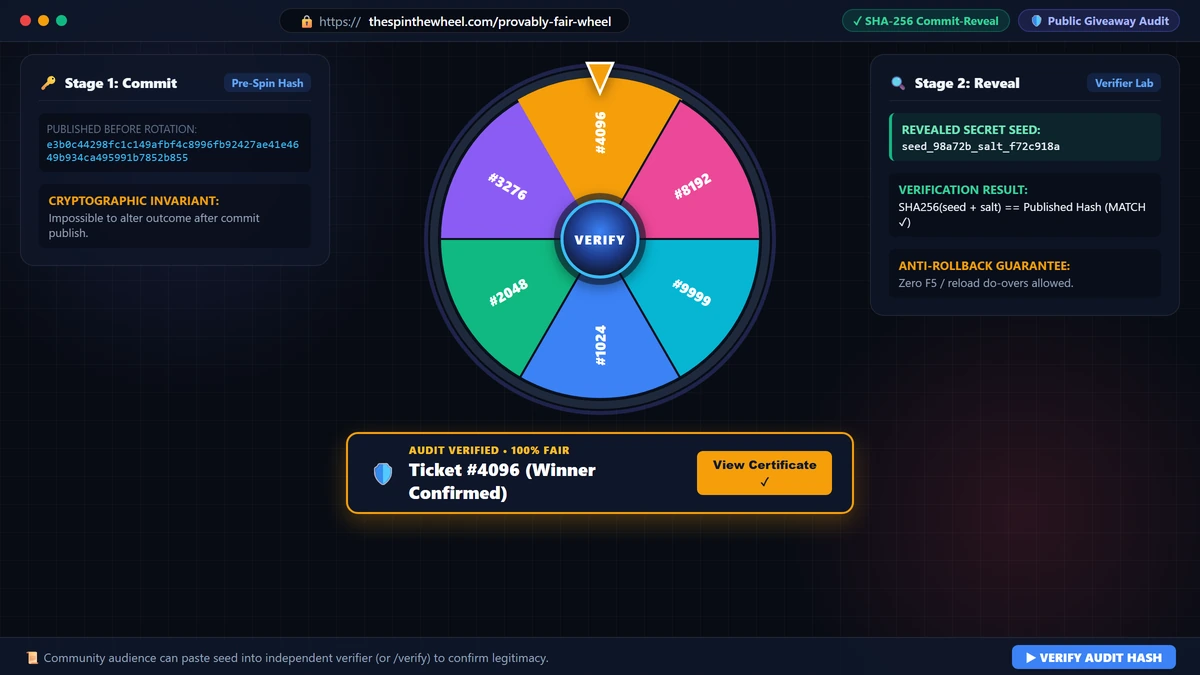
How to Run a Drama-Free Giveaway: 4-Step Streamer Guide
Run your live giveaway in four straightforward steps to keep the draw transparent and protect your stream from rigging claims:
Freeze Roster & Copy Hash
Paste your names into the roster box. The engine hashes the list and locks a 256-bit server seed into a SHA-256 commitment hash. Click Copy Hash and share the 64-character fingerprint in your Twitch, YouTube, Kick, or Discord chat before spinning.
Spin with Live Chat Entropy
Ask your chat for a public client seed (such as a viewer's word or the latest Bitcoin block hash). Hit SPIN (or press Space). The wheel spins and lands on the mathematically predetermined winner.
Reveal Seed & Share Audit Link
The winner popup reveals the secret server seed and creates an audit link (/verify#audit=...). Click Copy Audit Link and share it in chat so viewers can verify the hash match and replay the spin on their own screens.
Multi-Round Prize Protocol
Drawing multiple tiers (1st, 2nd, 3rd)? When you remove a winner, the engine increments the nonce (0 → 1 → 2) and generates a fresh server seed. Copy the new commitment hash before spinning the next round to keep every tier verifiable.
Provably Fair vs. Standard Wheels: Why Screen Recording Fails
Screen recordings do not prevent cheating. Anyone can record five spins off-camera, pick the one they like, and pretend it was live. A host can also edit names off-screen or hit refresh after an unwanted result. The breakdown below shows why commit-reveal math gives viewers actual proof that screen captures cannot match:
| Evaluation Criteria | Standard Wheels (e.g. Wheel of Names) | Third-Party Paid Draw (e.g. Random.org) | TheSpinTheWheel Provably Fair |
|---|---|---|---|
| Pre-Spin Commitment | ❌ None (Result only visible after spin) | ⚠️ Post-hoc signed timestamp | ✅ SHA-256 Hash displayed & locked before spin |
| Anti Re-Roll Defense | ❌ None (Host can F5 or re-spin undetected) | ⚠️ Paywalled drawing service ($4.95–$50+) | ✅ Re-spinning generates a different seed that fails hash match |
| Audience Seed Input | ❌ Host has unilateral control | ❌ Centralized black-box server generator | ✅ Viewers provide a client seed to influence the outcome |
| Independent Audit Tool | ❌ None (Trust host blindly) | ⚠️ Static text certificate | ✅ Dedicated audit verifier with step-by-step spin replay |
| Broadcast Overlay (OBS) | ❌ Solid background, manual chroma cropping | ❌ Not supported for live video | ✅ One-click transparent alpha and chroma green modes |
| Privacy & Data Security | Requires Google sign-in to save rosters | Stores participant PII on central servers | ✅ 100% Stateless (Zero database storage, zero PII logging, audit parameters encoded in URL fragment) |
| Usage Cost | Free with banner ads | Paywalled subscription or per-draw fee | ✅ 100% Free with unlimited spins and instant audits |
How Commit-Reveal Works: The Math Behind Untampered Spins
Every spin uses two industry standards: SHA-256 (FIPS 180-4) and HMAC-SHA256 (RFC 2104). As outlined in our cryptographic audit methodology, the draw runs through three clear phases:
Phase 1: Freezing the Participant Roster (Hentries)
When you add names to the roster, the engine normalizes them into a sorted JSON array and computes its 256-bit digest:
The Avalanche Effect: Cryptographic hash functions are extremely sensitive to input changes. Adding, deleting, or altering a single character or space in any entrant's name flips over 50% of the bits in Hentries, breaking the pre-spin commitment hash instantly:
["Alex", "Bella"] → 6ec4161d31f6eefb5777422a2acf2a02cf9d964563fcdb4e75e94268a5185190
["Alex ", "Bella"] → 89ab6ccd78d2cdbe01faef70792c3793c7f5ec334771c867cc40a808930da0ab
Visual proof: Adding a single space scrambles the entire 64-character hash. Modifying any entrant's name after announcing the hash causes an immediate mismatch in the audit verifier.
Phase 2: Locking the Secret Server Seed (Hcommit)
The engine generates a 32-byte server seed (Sserver) using hardware entropy via crypto.getRandomValues(). It then produces the public commitment:
Because SHA-256 is a one-way cryptographic hash function, neither the host nor viewers can predict the winner in advance. Yet the host is permanently bound to this seed and roster.
Phase 3: Calculating the Deterministic Winning Slice
When you click SPIN, HMAC-SHA256 calculates the outcome using Sserver as the secret key and Sclient + nonce as the message:
The first 8 hexadecimal characters (4 bytes) of the digest convert into an unsigned 32-bit integer I32. Dividing I32 by 232 produces a uniform decimal between 0 and 1, which selects the winning index:
The wheel animation decelerates to stop directly on this calculated slice.
Zero-Trust Audit: Verify Results in Your Browser Console (F12)
You do not have to take our word for it, nor do you have to rely solely on our audit verifier. Standard browser cryptography makes it easy to check the math yourself in your browser's Developer Tools Console (F12 → Console):
// Paste into Chrome/Firefox DevTools Console to independently verify any spin:
async function verifyProvablyFairSpin(serverSeed, clientSeed, nonce, entrants) {
    const enc = new TextEncoder();
    const key = await crypto.subtle.importKey(
        'raw', enc.encode(serverSeed), { name: 'HMAC', hash: 'SHA-256' }, false, ['sign']
    );
    const signature = await crypto.subtle.sign('HMAC', key, enc.encode(`${clientSeed}:${nonce}`));
    const hex = Array.from(new Uint8Array(signature)).map(b => b.toString(16).padStart(2, '0')).join('');
    const int32 = parseInt(hex.substring(0, 8), 16);
    const winningIndex = Math.floor((int32 / 0x100000000) * entrants.length);

    console.log(`Computed Winning Index: ${winningIndex}`);
    console.log(`Winning Participant: "${entrants[winningIndex]}"`);
    return entrants[winningIndex];
}
This script runs locally in your browser with zero network requests. If the calculated name matches the host's winner, you have mathematical proof that the result was locked before the spin began.
CSPRNG vs Math.random(): Why Hardware Entropy & Commitment Hashes Guarantee True Wheel Fairness
Examine full statistical Chi-Square distribution benchmarks across 1,000,000 rotations, Lemire integer rejection sampling, and browser Web Crypto API implementations.
Frequently Asked Questions About Provably Fair Giveaways
Why is a pre-spin commitment hash better than a screen recording?
Screen recordings can be stopped, edited, or re-recorded off-camera until a preferred outcome occurs. A pre-spin commitment hash cannot be faked because it is shared publicly with a timestamp before the draw begins. If the host tries a second spin, the revealed seed changes and fails verification.
What prevents a host from altering the entry list after generating the hash?
The commitment hash incorporates the SHA-256 fingerprint of the entire participant roster. Changing, adding, or deleting even a single character in any name produces a completely different hash on /verify, immediately flagging the draw as altered.
How does a public Client Seed prevent the host from rigging the draw?
Viewers or chat participants can supply the public client seed, such as a chosen chat word or recent block hash. Because the host does not control this input, they cannot pre-compute a server seed that favors any specific person.
How do I use this wheel inside OBS Studio or Streamlabs?
Click the OBS Alpha button in the streamer toolbar to enable 100% alpha transparency. Add a Browser Source in OBS pointing to https://thespinthewheel.com/provably-fair-wheel with dimensions 500x600. Control the wheel directly with your keyboard using Space to spin and R to remove winners.
How can viewers verify the winning outcome independently on the /verify page?
After the wheel stops, any viewer can open the public audit certificate on /verify. The independent verifier recalculates the SHA-256 HMAC hash using the revealed Server Seed, Client Seed, and participant roster. If the calculated slice index matches the live result, mathematical proof confirms the outcome was untouched and never re-spun.