20+ Classroom Wheel Spinner Activities: The K-12 Teacher Lesson Playbook
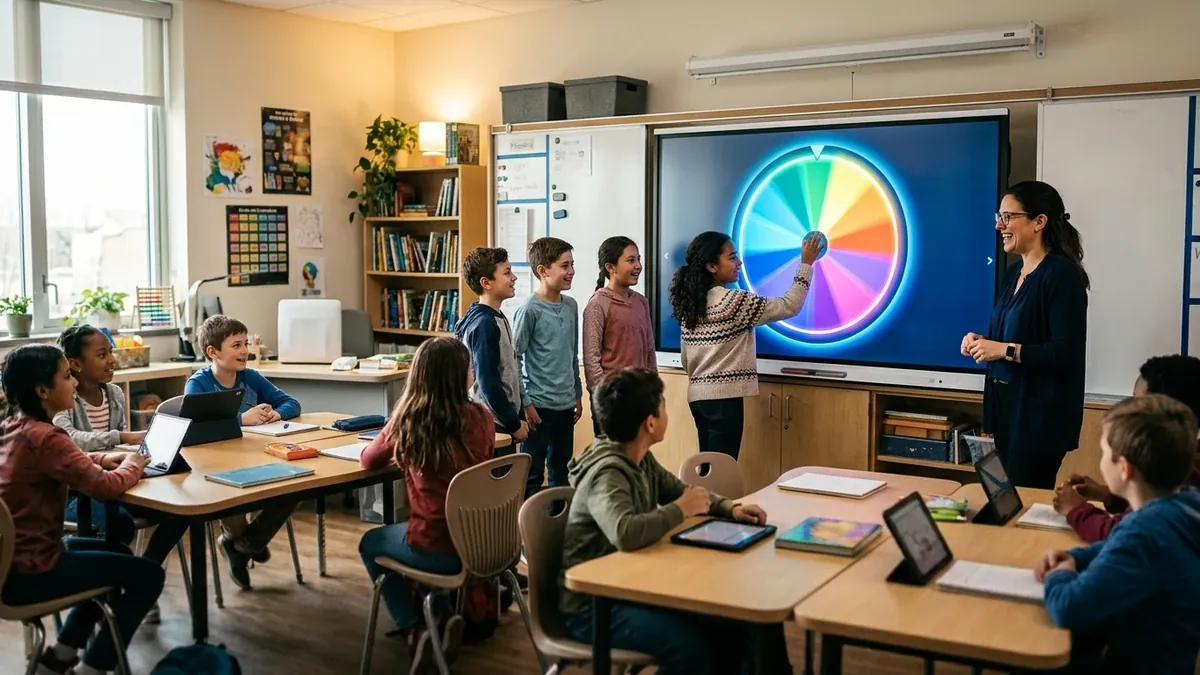
Transform daily instruction into dynamic, equitable learning moments with these 20+ curriculum-aligned classroom wheel spinner activities structured across Elementary (K-5), Middle School (6-8), and High School (9-12). Each routine integrates 5-to-15-minute pacing benchmarks, whole-class engagement mechanics, and 1-click Smartboard presets for frictionless execution. Requiring simultaneous response before every spin eliminates anxiety while guaranteeing active participation.
- The Engagement Protocol: How to Prevent the "Spectator Trap"
- Elementary School Routines (Grades K-5: Phonics, Numeracy, and Community)
- Middle School Dynamic Relays (Grades 6-8: STEM and Vocabulary)
- High School Seminar Mastery (Grades 9-12: Socratic Probes and Synthesis)
- Ready-to-Paste Wheel Prompt Banks for Daily Instruction
- Interactive Smartboard Presets and One-Click Setup Guide
The Engagement Protocol: How to Prevent the "Spectator Trap"
The primary failure mode of digital classroom selectors is the "Spectator Trap." When a question is announced and a wheel spun immediately, uncalled students disengage. Educators prevent this drift and uphold Universal Design for Learning (UDL) by decoupling prompts from selection via an All-Student Response System (ASRS).
Never spin until every student has committed an answer to paper, mini-whiteboard, or partner whisper. The spinner chooses who shares, not who thinks.
For rapid lesson planning during transitions, scan this 5-second reference matrix:
| Activity Routine | Grade & Subject | Pacing & Wheel Mode |
|---|---|---|
| Phonics Blitz | K-1 (Reading) | 5m (/letter-wheel-spinner) |
| Math Fact Sprints | 2-3 (Arithmetic) | 8m (/random-number-wheel) |
| Morning Meeting | K-5 (SEL) | 10m (/classroom-name-picker) |
| Vocab Showdown | 6-8 (ELA) | 10m (Elimination Mode) |
| STEM Variables | 6-8 (Science) | 12m (Conditions Wheel) |
| Lab Cohorts | 6-8 (Collaborative) | 30s (/team-picker-wheel) |
| Socratic Stems | 9-12 (Humanities) | 15m (Inquiry Wheel) |
| 60s Rebuttals | 9-12 (Civics) | 12m (Stance Wheel) |
| Six-Word Summary | 9-12 (Exit Ticket) | 7m (/classroom-name-picker) |
| Dual Mashup | 9-12 (Creative/STEM) | 15m (Dual Side-by-Side) |
While conventional dogma warns that cold calling causes anxiety, research shows random selection only triggers distress when students answer without preparation. Paired with think-time, randomized selection democratizes participation and prevents vocal dominance. For analysis, explore our guide on cold calling students without anxiety.
The Mini-Whiteboard Rule: Active Response Before the Spin
Before spinning the Classroom Name Picker, the teacher enforces a 30-to-45-second writing window. Teachers deploy three zero-cost response modalities:
- Mini-Whiteboards: Students write terms or numbers and hold boards up on count.
- Binary Hand Signals: Students signal thumbs-up/down or finger numbers for rapid checks.
- Turn-and-Talk Whisper: Desk pairs share their 20-second justification before the spin.
- Prompt Delivery: Project the question stem on screen.
- Silent Commitment: All students record answers via their chosen modality (30s).
- Boards Up / Scan: Teacher conducts a 3-second whole-class visual check.
- The Reveal Spin: The wheel selects who shares and expands on their reasoning.
This routine converts individual evaluation into collective accountability, ensuring every learner processes the core concept.
Low-Stakes Lifelines: "Phone-a-Peer" and the 5-Second Scaffolding Rule
When a selected student hesitates, teachers protect psychological safety. Under the 5-Second Scaffolding Rule, if formulation stalls past five seconds, the teacher triggers a lifeline:
- Phone-a-Peer: The student chooses a peer for a hint, then restates the explanation in their own words.
- Option Narrowing: The teacher eliminates two incorrect choices, converting the question into a binary comparison.
- Re-spin with Cue: The student receives a clue and gets priority on the subsequent spin.
Normalizing these scaffolds removes the fear of public failure and reframes errors as collaborative learning data.
The Pass Line System and Elimination Mechanics
Distribute two private "Pass Tokens" per term for penalty-free passing. Simultaneously, enable Remove Name After Pick on the digital spinner so contributed slices disappear:
| Classroom Calling Metric | With Slice Elimination | Without Slice Elimination |
|---|---|---|
| Probability of Repeat Call | 0.00% (Guaranteed Fair) | Constant 1/N per turn |
| Pacing Predictability | High (Finite Roster) | Irregular (Clustering Bias) |
| Student Re-engagement | Sustained via Whiteboards | Drops if Student Feels Safe |
Once every roster member has participated, the software resets the wheel with a single click, ensuring seamless transition speed and complete student fairness without the clutter of physical cups and wooden craft sticks.
Elementary School Routines (Grades K-5: Phonics, Numeracy, and Community)
Elementary learners thrive on rhythm, color, and predictable routines. Digital wheels turn drills into engaging rituals.
| Elementary Activity | Grade & Focus | Wheel Mode Configuration |
|---|---|---|
| Phonics Sound Blitz | Grades K-1 (ELA) | Letter Wheel (Single Phonemes) |
| Math Fact Elimination | Grades 2-3 (Math) | Number Wheel (Products & Factors) |
| Morning Meeting Spark | Grades K-5 (SEL) | Category Wheel (Emotion & Sharing) |
Phonics Decoding and Sight Word Rapid Recognition
In literacy stations, replace flashcards with the Letter Wheel Spinner for orthographic mapping:
- Pacing: 5 to 7 minutes daily.
- Mechanics: Populate slices with consonant blends (such as bl, tr, st, ch, sh) or Dolch sight words. When the pointer stops, the class chorally articulates the sound, followed by the selected student using it in a sentence.
- Kinesthetic Twist: Students sky-write letters before decoding aloud.
Math Fact Fluency and Place Value Sprints
Arithmetic fluency requires distributed practice. The Random Number Wheel enables stress-free numeracy warmups:
- Pacing: 8 to 10 minutes.
- Multiplication Relay: Configure numbers 1 through 12. Announce a target multiplier (such as 7). When the wheel lands on "9", students compute $7 \times 9 = 63$ on boards.
- Place Value Challenge: Spin a single-digit wheel three times. Students arrange the digits into the greatest possible number in expanded notation.
Morning Meeting Starters and Community Builders
Morning meetings set the emotional climate for the day:
- Pacing: 10 minutes.
- SEL Emotion Check-In: Load slices with feeling words (Calm, Focused, Excited, Anxious). Drawn students share one sentence on their mood.
- Would You Rather Sprints: Populate slices with choices (such as Outer space or deep ocean?). Students vote by moving to room sides.
Classroom Job Allocation with Elimination Mode
Automating chore assignments with slice elimination eliminates disputes over helpers:
- Pacing: 5 minutes on Monday morning.
- Protocol: Load the roster. Spin to assign roles. Enable slice removal to prevent duplicate assignments until all duties are filled.
Middle School Dynamic Relays (Grades 6-8: STEM and Vocabulary)
Adolescent students fear peer embarrassment. Structured relays channel social energy into academic mastery.
| Middle School Activity | Subject & Time | Wheel Configuration |
|---|---|---|
| Tier-2 Vocab Showdown | ELA (10 Min) | Academic Vocabulary Slices |
| Variable Shuffler | Science (12 Min) | Experimental Factors Wheel |
| Historical Roleplay | Social Studies (15 Min) | Historical Figure Slices |
Tier-Two Academic Vocabulary Showdown and Dramatic Sentences
Reading comprehension hinges on Tier-2 terms like synthesize, refute, evaluate, and conjecture:
- Pacing: 10-minute warmup.
- Rule: Load 20 unit terms. Spin a word. Groups collaborate for 30 seconds to deliver a definition, translation, and 10-second pantomime.
STEM Hypothesis and Variable Shuffler
Inquiry requires distinguishing independent, dependent, and controlled variables:
- Pacing: 12 to 15 minutes during lab introductions.
- Protocol: Create an "Experimental Conditions Wheel" with testable variables (Light intensity, Soil pH, Fertilizer concentration, Temperature).
- Execution: Spin to set the independent variable. Lab pairs draft a hypothesis using the standard "If [IV], then [DV]" framework.
Historical Perspective-Taking and Roleplay Debates
Random perspective-taking forces historical analysis through multiple social lenses:
- Pacing: 15 minutes.
- Setup: For the Gilded Age or Magna Carta, load archetypes: factory owner, child laborer, union organizer, immigrant merchant.
- Discussion: Present a dilemma. Spin to determine which social class each group represents in a 3-minute Town Hall debate.
Fast 4-Person Lab Station Cohort Partitioning
Grouping students manually wastes transition time. Educators outsource assembly to the Team Picker Wheel:
- Pacing: Under 30 seconds.
- Execution: Paste the student roster, select 4 members per team, and generate balanced cohorts. Project the team rosters on the Smartboard so students transition immediately without negotiation.
High School Seminar Mastery (Grades 9-12: Socratic Probes and Synthesis)
High school instructors use random spinners to elevate analytical rigor and conduct formative checks during advanced coursework.
| High School Activity | Academic Focus | Wheel Dynamic |
|---|---|---|
| Socratic Seminar Stems | AP Lit & Humanities (20 Min) | Analytical Inquiry Stems |
| 60-Second Rebuttal | Civics & Debate (15 Min) | Stance & Bias Modifiers |
| Six-Word Summary | Universal Exit Check (7 Min) | Synthesized Reflection Modes |
Socratic Seminar Question Stems and Counterargument Probes
Deepen seminar discussions by using the wheel to inject analytical inquiry stems into student-led dialogues:
- Pacing: 15 to 20 minutes of block scheduling.
- Inquiry Stems: Populate slices with stems like "What unstated premise underlies this argument?" or "What contradictory evidence does the author minimize?"
- Seminar Protocol: When discussions lull, the moderator spins the wheel to force participants to explore fresh angles.
60-Second Rebuttal and Stance Reversal Drills
Civic literacy requires defending nuanced claims under time pressure:
- Pacing: 12 minutes.
- Protocol: A student presents a 60-second claim on a constitutional issue. Immediately upon completion, the teacher spins a "Perspective Stance Wheel" containing viewpoints: Economic Libertarian, Strict Constructionist, Environmental Preservationist.
- Challenge: The respondent has 30 seconds to construct a 1-minute rebuttal from the assigned viewpoint.
Formative Exit Tickets: The Six-Word Lesson Summary
Closing an instructional block requires cognitive synthesis to lock in retention:
Pacing: Final 7 minutes of class. Prompts: Load the wheel with three closing synthesis challenges: 1. The 6-Word Summary: Encapsulate today's core thesis in exactly six words. 2. The Analogy Anchor: Construct an analogy connecting today's topic to modern technology. 3. The Muddiest Point: Pinpoint the single concept that remains confusing. * Outcome: Students submit responses on exit slips before dismissing, providing immediate feedback for subsequent lesson planning.
Dual-Wheel Creative Mashup: Subject Meets Complexity
For creative writing or science modeling, educators open two browser windows side by side for a Dual-Wheel Mashup:
- Wheel 1 (Subject / Anchor): Characters, chemical compounds, or historical eras.
- Wheel 2 (Constraint / Challenge): Literary conflict, unexpected catalyst, or opposing rhetorical tone.
Spinning both simultaneously generates unforeseen intersections (such as King Lear in a cyberpunk setting), sparking lateral problem-solving.
Ready-to-Paste Wheel Prompt Banks for Daily Instruction
Copy and paste the raw text blocks below directly into your classroom wheel spinner to eliminate prep time.
Bank A: Morning Meeting and Social-Emotional Prompts
Copy this block into your morning meeting wheel to facilitate low-stakes community building:
Bank B: Universal Formative Assessment Exit Prompts
Paste these reflection prompts into your closing wheel to evaluate lesson retention across any subject:
Bank C: High-Yield Socratic Discussion Starters
Copy these inquiry stems into your seminar wheel to break analytical deadlocks and elevate critical thinking:
Interactive Smartboard Presets and One-Click Setup Guide
Modern classrooms require zero-friction tools. Cloud logins on shared PCs introduce unnecessary friction and security concerns. Under FERPA and COPPA, roster data must never be stored in remote databases. For details, examine our research on COPPA and FERPA classroom safety or launch our ad-free Classroom Name Picker.
Interactive Flat Panel (IFP) and Smartboard Best Practices
To maximize legibility across modern Interactive Flat Panels (IFPs like Promethean, ViewSonic, SMART) and displays:
- High-Contrast Palette: Ensure high contrast against ambient light so text stands out under fluorescent bulbs.
- Radial Font Optimization: Select tools with dynamic font scaling that automatically expands short names and compacts long entries.
- Acoustic Sensory Comfort: Set tick sounds to moderate levels. A gentle click provides anticipation without acoustic sensory overload for neurodivergent learners.
Bookmarkable Hash Presets for Daily Classroom Routines
Managing spinners across period changes is optimized via stateless URL hash bookmarking:
- Stateless Compression: When you paste a student roster or question bank into the spinner, modern web applications compress items directly into the URL fragment (
#wheel=...). - Instant 2-Second Launch: Bookmark the configured URL in your browser bar ("Period 1 Biology Roster" or "Math Warmup Sprints").
- Zero Login Friction: Clicking bookmarks launches configured wheels on Smartboards in under two seconds—without logins, passwords, or data transmission.
By integrating these grade-banded activities, structured participation protocols, and ready-to-paste prompt banks into your daily instructional flow, you can elevate student voice, eliminate classroom downtime, and build an equitable community of active thinkers.\n
Ready to Transform Your Classroom Participation?
Launch the ad-free, 100% COPPA-compliant student turn selector on your classroom Smartboard in seconds—no account or login required.