Random Group Generator for the Classroom: The Drama-Free Teacher's Playbook
Unstructured student grouping triggers friendship negotiations, off-task bargaining, and social anxiety that drains instructional time. By pairing transparent digital randomization with structured pod sizing, Spencer Kagan's PIES principles, a three-minute buffer, and automatic Captain roles, educators eliminate classroom drama and establish balanced cooperative learning pods in under sixty seconds.
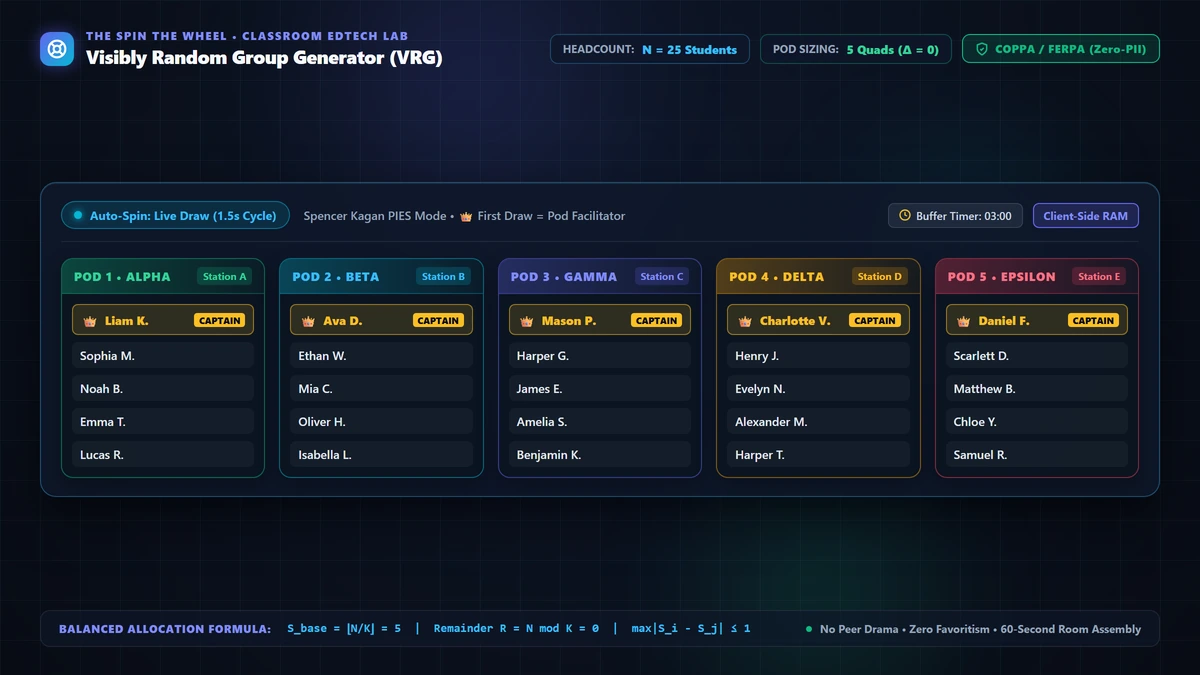
Table of Contents
Group Sizing and Remainder Math: Dyads, Quads, and Odd Rosters
Optimal group sizing matches task complexity: pairs maximize verbal processing, while four-student quads support multifaceted roles. Aligning pod configurations with Cooperative Learning Pod Sizing standards prevents confusion and ensures tasks achieve clear pedagogical goals.
Dyads vs Quads: Selecting Optimal Pod Sizes for Academic Tasks
Dyads (pairs) and quads (four-student teams) represent primary cooperative learning topologies. In a 2-student dyad, each learner gets 50% of the active talking and thinking time. Dyads provide the ideal format for formative turn-taking, peer editing, math partner checks, and rapid think-pair-share prompts with zero hiding spots.
Four-student quads serve as the classroom standard for multifaceted group work, inquiry science labs, and seated projects with designated roles. Peter Liljedahl's Building Thinking Classrooms research shows that 3-student triads work best for problem-solving at vertical whiteboards. However, at seated desks, triads often turn into an awkward two-against-one dynamic, while groups of five or more invite passive loafing.
| Group Topology | Active Talk Time | Optimal Academic Modality | Social Loafing Risk |
|---|---|---|---|
| Dyad (2 Students) | 50% per student | Think-Pair-Share, reading checks, peer editing | 0% (Zero hiding spots) |
| Triad (3 Students) | 33% per student | Vertical whiteboard problem-solving (BTC), quick brainstorms | Moderate (2-vs-1 risk) |
| Quad (4 Students) | 25% per student | Inquiry labs, jigsaw tasks, multifaceted group projects | Low (Controlled via roles) |
| Quintet+ (5+ Students) | ≤ 20% per student | Whole-table debates, large theatrical skits | High (Passive loafers) |
When to Randomize vs When to Handcraft: The Grouping Decision Matrix
Random grouping excels at building classroom community and breaking social cliques, but teachers must recognize when intentional ability clustering is necessary:
| Instructional Scenario | Grouping Modality | Pedagogical Rationale |
|---|---|---|
| Think-Pair-Share & Review Games | Visibly Random Generator | Maximizes peer mixing and eliminates perceived teacher bias. |
| Vertical Whiteboard Problem-Solving | Visibly Random Triads (BTC) | Optimizes active thinking at non-permanent surfaces without loafing. |
| Cooperative Projects & Labs | Visibly Random Quads (Kagan) | Balances cognitive diversity with four structured functional roles. |
| Targeted Tiered Remediation | Strategic Ability Tracking | Foundational skill gaps require leveled instruction rather than chance. |
The Remainder Math: Managing Odd Rosters Fairly
Classroom enrollments rarely divide cleanly into perfect quads. Uneven headcounts of 25, 27, or 29 students pose an immediate sorting challenge. The Balanced Allocation Formula handles odd numbers cleanly by distributing remainder students evenly across teams using integer floor division and modulo arithmetic:
Here, N is headcount, K is team count, Sbase defines baseline group size, and R represents remainder count. The algorithm distributes the R remainder learners across the first R groups, producing teams sized at either Sbase or Sbase + 1.
The condition max |Si - Sj| ≤ 1 guarantees no team differs by more than one student. Splitting 25 students into 6 groups yields one team of 5 and five teams of 4, eliminating awkward 2-person remainder pods. Similarly, partitioning 27 students into 7 groups produces six teams of 4 and one team of 3, maintaining workload parity across the room.
Rotation Pacing and Optimal Reshuffling Frequency for Classroom Teams
Reshuffling frequency must mirror task duration. Fast formative pairs deployed during daily warm-ups benefit from regular re-spinning, training learners to collaborate comfortably with every peer.
For project quads, maintain stable teams for 10 to 14 consecutive school days. This 2-to-3 week window allows pods to navigate Bruce Tuckman's developmental stages without trapping learners in dysfunctional partnerships. Reshuffling earlier disrupts forming norms, while extending past 15 days causes social fatigue.
Interactive Smartboard Setup and The Random Captain Selection
Projecting the digital randomizer directly onto the interactive board brings Peter Liljedahl's concept of Visibly Random Groups (VRGs) from Building Thinking Classrooms to life. When students watch the algorithm distribute rosters live on screen rather than receiving a pre-engineered list, suspicions of teacher favoritism vanish and resistance turns into shared anticipation.
One-Click Roster Import from Gradebooks and Google Classroom
Manual roster entry during class wastes precious teaching minutes. Modern team sorters streamline setup by accepting raw text exports directly from Google Classroom or Student Information Systems. Teachers copy first names with last initials (such as Sophia M. or Liam K.) and paste the list into the entries drawer in under 30 seconds, keeping student identities safe.
Pre-Spin Roster Hygiene: Preventing Known Combustible Dynamics
Proactive teachers keep a quiet mental or private list of incompatible student pairs, separating them across roster blocks before projecting onto the board. If two students have documented harassment histories or deep-seated personal conflict, placing them into non-adjacent blocks or running a quick private shuffle prevents combustible pairings before sharing the screen.
Hands-Free Auto-Spin: Eliminating 30 Repetitive Teacher Clicks
Spinning a manual spinner thirty times creates awkward downtime. Instructors rely on the Team Picker Wheel with hands-free Auto-Spin to cycle through the entire class roster automatically.
The automated sequence runs rapid 1.5-second spin cycles, filling team columns while the teacher moves freely around the room to check student readiness. As names snap into place, the visual momentum holds everyone's attention without requiring manual clicks from the teacher.
The Captain Badge: Designating the First Drawn Student as Pod Leader
Clear roles prevent hesitation when teams first sit down. Assigning practical Classroom Functional Roles begins during the generation sequence itself. The first student randomly placed into each team column automatically receives the digital Captain 👑 badge on screen.
This automated badge provides an instant visual signal: the Captain knows to pick up the team folder and start the warm-up prompt without delay. Algorithmic role assignment eliminates social posturing for control, giving quiet students regular opportunities to lead.
Zero-PII Compliance Under Federal Student Privacy Statutes
Protecting student privacy requires strict compliance with federal Student Privacy Statutes, including COPPA (16 CFR Part 312) and FERPA (34 CFR Part 99). Cloud tools requiring teacher logins or syncing student rosters to remote servers create compliance risks (see our review of ad-free classroom spinner alternatives).
The Spin The Wheel runs on a zero-PII client-side Canvas engine. All text processing, randomization, and rendering happen locally inside browser RAM. Zero bytes of student data reach external servers, and closing the browser tab purges all names from device memory immediately. Review full technical specifications in our benchmark report on COPPA classroom data privacy.
Defeating the 'Dead-Weight' Fear: Individual Accountability for High Achievers
Alleviating high achievers' fear of carrying unmotivated teammates requires separating individual mastery grades from collective group projects. Capable students resist collaborative work when traditional grading systems tie their personal marks to peer effort.
Kagan's PIES Framework: Engineering Positive Interdependence
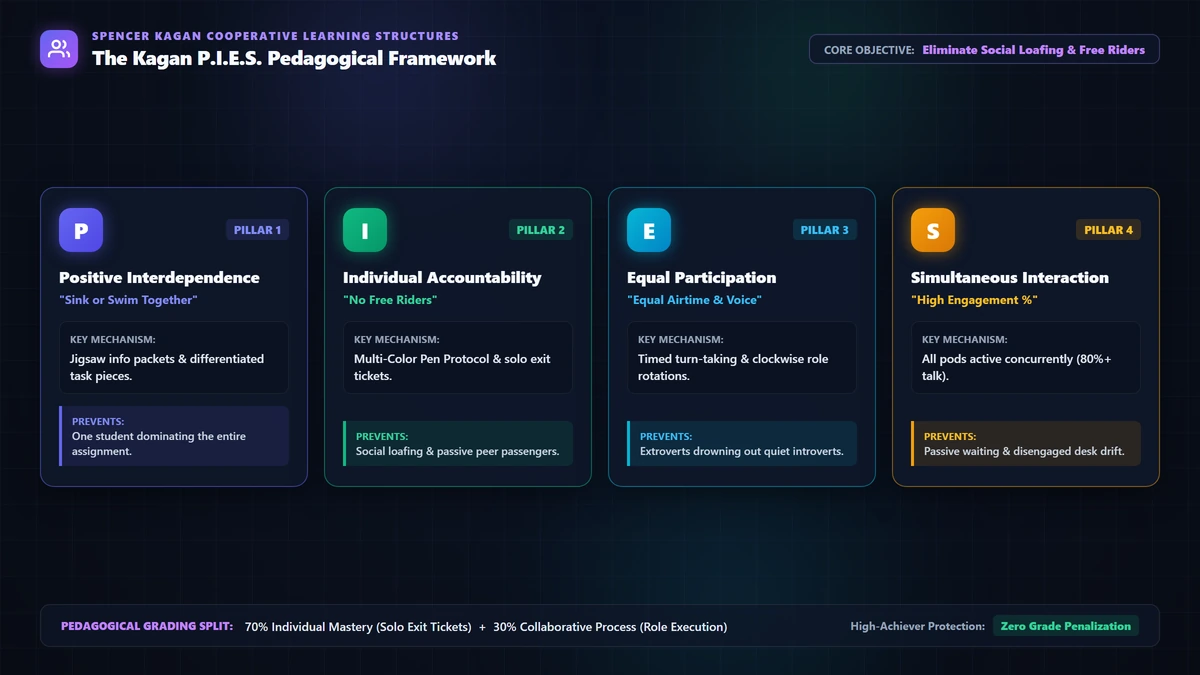
To build authentic collaborative balance, group tasks should align with Spencer Kagan Cooperative Learning Structures, centered on the four PIES principles: Positive Interdependence, Individual Accountability, Equal Participation, and Simultaneous Interaction.
Positive Interdependence means the assignment cannot be finished unless every member contributes their piece. By providing jigsawed information packets or assigning differentiated calculations across team members, teachers make cooperation a structural necessity rather than an empty request.
| Kagan PIES Principle | Operationalization | Classroom Mechanism | Failure Mode Prevented |
|---|---|---|---|
| Positive Interdependence | Shared victory through differentiated inputs | Jigsaw information packets; single team whiteboard | One student dominating the task |
| Individual Accountability | Mandatory personal performance artifact | Multi-Color Pen Protocol; solo exit tickets | Social loafing and passive passengers |
| Equal Participation | Regulated speaking time and turn-taking | Timed partner shares; clockwise role execution | Extroverts drowning out introverts |
| Simultaneous Interaction | High percentage of room actively engaged | All pods working simultaneously | Passive waiting during lectures |
The Multi-Color Pen Protocol for Collaborative Worksheets
The Multi-Color Pen Protocol provides instant visual proof of equal contribution. In a 4-student quad, each member writes with a distinct ink color (Student 1 Blue, Student 2 Green, Student 3 Red, Student 4 Black).
Students must write every calculation, citation, and summary in their assigned ink color. Circulating teachers can assess participation balance across the entire room in under 5 seconds from 15 feet away. If a poster shows 80% Blue and only 5% Red ink, the teacher intervenes constructively without relying on student complaints.
Assigning Core Classroom Functional Roles
Structuring collaboration around Classroom Functional Roles distributes responsibility clearly, preventing confusion from stalling progress:
- The Facilitator (Captain 👑): Guides the group through assignment directions, ensures everyone understands tasks, and tracks the countdown timer.
- The Scribe (Recorder): Captures team consensus on the master assignment sheet and ensures formatting matches the scoring rubric.
- The Resource Manager: Collects lab supplies, sharpens pencils, distributes paper, and serves as the only student permitted to ask the teacher questions.
- The Spokesperson (Reporter): Shares the team's key findings during whole-class debriefs. Teachers combine this role with low-stakes cold-calling strategies to keep all students engaged.
Individual Accountability Grading vs Collective Product Grading
Grading group work with a single shared grade penalizes conscientious students while rewarding disengaged teammates. Teachers resolve this grading tension with a practical 70/30 split:
- 70% Individual Mastery Score: Graded through individual exit tickets, short quizzes, or personal reflection paragraphs completed independently at the end of the lesson.
- 30% Collaborative Process Score: Awarded for the completed team poster, collaborative lab calculations, and reliable execution of assigned functional roles.
This clear separation reassures high-achieving students and their families that individual grades reflect personal mastery regardless of team placements.
Edge-Case Troubleshooting: Chronic Partner Refusals and Toxic Pairings
Handling acute interpersonal conflict, sensory overload, or mid-period attendance changes calls for calm, pre-planned routines rather than improvising in front of the room. Clear procedures for exceptional situations protect student dignity and keep lessons moving forward smoothly.
De-escalating Severe Conflict and Active Anti-Bullying Situations
Teachers must distinguish between casual complaining ("I don't want to work with them") and documented harassment, trauma, or 504/IEP accommodations. Forcing students with active harassment histories into mandatory partnerships violates basic emotional safety standards.
When an automated sort pairs students with documented conflict or active anti-bullying plans, intervene quietly. The teacher quietly swaps one student with an adjacent volunteer. Alternatively, activate the Parallel Workstation Option: allow a student experiencing acute sensory or social overwhelm to complete the same assignment at a quiet individual table without grade penalty.
Managing Mid-Lesson Absences and Late-Arriving Students
Class headcounts shift constantly due to tardiness, nurse visits, and early dismissals. When a student arrives 20 minutes into class, avoid breaking apart an established pair to create a triad, as rearranging seats disrupts focused workflows.
Instead, add late arrivals to existing 4-student quads as secondary Specialists (such as Quality Auditor or Fact Checker). If a student leaves early, remaining group members simply absorb that peer's functional role, allowing the team to finish their assignment without losing momentum.
Pair automated grouping with individual tools like the Classroom Name Picker for low-stakes calling and our resource on classroom spinner activities for review games. Together, these routines create a transparent, engaging, and drama-free room where every student thrives.